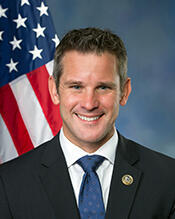
Adam Daniel Kinzinger (born February 27, 1978) is an American politician, political commentator, and former United States Air Force and Air National Guard officer who served as a Republican U.S. Representative from Illinois from January 3, 2011, to January 3, 2023. Over six terms in Congress, he represented Illinois’s 11th congressional district and, following redistricting after the 2010 census, Illinois’s 16th congressional district. During his tenure in the House of Representatives, Kinzinger participated actively in the legislative process, represented the interests of his constituents, and became nationally known for his positions on national security, foreign policy, and, later, his outspoken criticism of President Donald Trump’s efforts to overturn the 2020 presidential election.
Kinzinger was born in Kankakee, Illinois, the son of Betty Jo, an elementary school teacher, and Rus Kinzinger, a chief executive officer of religious faith–based organizations. He spent part of his early childhood in Jacksonville, Florida, before his family settled primarily in Bloomington, Illinois. He graduated from Normal Community West High School in 1996. He went on to attend Illinois State University in Normal, where he earned a bachelor’s degree in political science in 2000. While still a student at Illinois State, he entered local politics; in 1998, at age 20, he successfully ran for a seat on the McLean County Board, defeating an incumbent and becoming one of the youngest county board members in the county’s history. He served on the McLean County Board until his resignation in 2003. Shortly after graduating from Illinois State, he also worked as an intern for U.S. Senator Peter Fitzgerald as part of a university program, gaining early exposure to federal legislative work.
In 2003, Kinzinger resigned from the McLean County Board to join the United States Air Force. Commissioned as a second lieutenant in November 2003, he earned his pilot wings and began his military aviation career as a KC-135 Stratotanker pilot, flying missions in South America, Guam, Iraq, and Afghanistan. He later transitioned to flying the RC-26 surveillance aircraft and was stationed in Iraq on two occasions. Over the course of his service in the Afghanistan and Iraq wars, he was awarded the Air Medal six times. Kinzinger served in the Air Force Special Operations Command, Air Combat Command, Air Mobility Command, and later in the Wisconsin Air National Guard, rising to the rank of lieutenant colonel. As part of his continued Guard service, he was deployed to the Mexico–United States border in February 2019 in support of border security operations. He retired from the Air National Guard after completing 20 years of military service.
Kinzinger’s path to Congress began while he was still on active military duty. In January 2009, he met with Republican U.S. Representatives Mike Pence, Mark Kirk, and Peter Roskam to discuss a potential run for Congress. He decided to seek election in Illinois’s 11th congressional district, then represented by Democrat Debbie Halvorson. Returning from his third tour in Iraq in May 2009, he began campaigning full-time. He received the endorsement of former Alaska Governor Sarah Palin and won the five-candidate Republican primary on February 2, 2010, with 64 percent of the vote. In the general election, he was endorsed by both the Chicago Tribune and the Chicago Sun-Times and defeated Halvorson by a margin of 57 to 43 percent on November 2, 2010. During his first term, he represented a district that extended from the outer southern suburbs of Chicago to the Bloomington–Normal area.
Following the 2010 census, Illinois underwent redistricting that significantly altered Kinzinger’s political landscape. His 11th district was effectively eliminated, and much of its eastern portion, including his home in Channahon near Joliet, was merged into the Rockford-based 16th congressional district, then represented by Republican Don Manzullo, who had first been elected in 1992. Before redistricting, Kinzinger had represented about 31 percent of the newly drawn district, while Manzullo had represented at least 44 percent. Backed in part by then–House Majority Leader Eric Cantor, who viewed him as a rising Republican figure, Kinzinger challenged Manzullo in the March 2012 Republican primary and defeated him 56 to 44 percent. In the subsequent general election, he defeated Democratic nominee Wanda Rohl with 62 percent of the vote. He was targeted by the Club for Growth in the 2014 Republican primary and faced David Hale, a nurse and founder of the Rockford Tea Party, but prevailed with 78 percent of the vote and went on to defeat Democrat Randall Olsen with 71 percent in the general election. In 2016, he ran unopposed in the Republican primary, received 100 percent of the primary vote, and, with no Democratic candidate on the ballot, won the general election with 99.9 percent of the vote.
Throughout his congressional career, Kinzinger maintained a generally conservative voting record while at times breaking with his party on high-profile issues. In 2010, he signed a pledge sponsored by Americans for Prosperity promising to oppose any global warming legislation that would raise taxes. He voted for the 2017 Republican healthcare legislation aimed at repealing major portions of the Affordable Care Act and supported the Tax Cuts and Jobs Act of 2017. He sponsored the Veteran Emergency Medical Technician Support Act of 2013, intended to ease the transition of veterans with military EMT training into civilian licensing; the bill passed the House by voice vote but did not receive a vote in the Senate. On June 5, 2014, he introduced H.R. 4801 (113th Congress), directing the Secretary of Energy to report on the effects of thermal insulation on energy consumption and potable water systems in federal buildings, arguing that maximizing energy savings in federal facilities was a commonsense step. He was a member of both the Republican Study Committee and the Republican Main Street Partnership. The Lugar Center and the McCourt School of Public Policy ranked him the 40th most bipartisan member of the House, and the third most bipartisan among Illinois House members, during the 114th Congress, based on patterns of cross-party bill sponsorship and co-sponsorship.
Kinzinger’s relationship with the national Republican Party leadership and its presidential standard-bearers evolved over time. On August 3, 2016, during the presidential campaign, he publicly announced that he would not support Republican nominee Donald Trump, stating in a CNN interview that he considered himself “an American before [a] Republican” and believed Trump had upended core Republican principles. He also declined to support Democratic nominee Hillary Clinton and indicated he was considering other options. In the years that followed, he became increasingly critical of Trump’s rhetoric and conduct. During the COVID-19 pandemic, he frequently singled out China for blame in public statements and social media posts, including a tweet reading, “Daily reminder: You are in your homes because #Chinahidthevirus,” prompting criticism from an Asian American op-ed writer who accused him of stoking racial animus at a time of rising anti-Asian hate crimes and coronavirus-related discrimination.
After President Trump lost the 2020 presidential election, Kinzinger emerged as one of the most vocal Republican opponents of Trump’s unfounded claims of widespread voter fraud and efforts to overturn the election results. On January 6, 2021, the day of the attack on the U.S. Capitol, he later recounted having an uneasy feeling and advised his wife not to attend the joint session of Congress to certify the Electoral College vote. He instructed his staff not to come to the office that day and carried his .380 caliber Ruger LCP handgun to the Capitol and the Rayburn House Office Building. After receiving an email from the Capitol Police at approximately 2:18 p.m. directing members to stay away from windows, lock doors, remain quiet, and silence electronics, he barricaded the doors of his office and drew his weapon. In the months that followed, he consistently condemned the attack and efforts to minimize or deny its significance.
In the 117th Congress, Kinzinger frequently broke with most of his Republican colleagues on matters related to January 6 and political extremism. On February 4, 2021, he was one of 11 House Republicans who joined all voting Democrats to strip Representative Marjorie Taylor Greene of her assignments on the House Education and Labor Committee and the House Budget Committee in response to her controversial statements. In March 2021, he was one of eight Republicans to vote for the Bipartisan Background Checks Act of 2021, which sought to expand background checks for firearm purchases. On April 9, 2021, he publicly called for Representative Matt Gaetz to resign amid a federal investigation into alleged sex trafficking. On May 19, 2021, Kinzinger joined 34 other House Republicans and all 217 Democrats present in voting to establish a National Commission to Investigate the January 6th Attack on the United States Capitol Complex; after the measure was blocked in the Senate by a Republican filibuster, he remained committed to pursuing accountability. When House Republican leaders threatened to sanction members who might participate in a select committee on the attack, Kinzinger criticized the threats and, on July 25, 2021, accepted Speaker Nancy Pelosi’s appointment to the House Select Committee to Investigate the January 6th Attack. In a September 5, 2021, appearance on CNN’s “State of the Union,” he argued that the Republican Party “desperately needs to tell the truth,” warning that if it continued to promote lies, conspiracy theories, and division, it did not deserve to hold congressional majorities.
Kinzinger continued to support certain major bipartisan initiatives even as he grew more estranged from much of his party’s base. On November 5, 2021, he was one of 13 House Republicans who joined a Democratic majority in voting for the Infrastructure Investment and Jobs Act, a sweeping package to fund transportation, broadband, and other infrastructure projects. In the 2018 midterm elections, he defeated Democratic challenger Sara Dady with 59.1 percent of the vote and, after a series of Republican losses in the Chicago metropolitan area, became the only Republican representing a significant portion of northern Illinois in Congress. In the 2020 election, he defeated Democrat Dani Brzozowski with 65 percent of the vote. On October 29, 2021, after Illinois adopted a new congressional map that placed him and fellow Republican Representative Darin LaHood in the same district—a district that was geographically more his than LaHood’s—Kinzinger announced that he would not seek reelection in 2022. He completed his sixth term on January 3, 2023, concluding a congressional career that spanned a period of intense political polarization and institutional strain.
After leaving office, Kinzinger transitioned to a role in political media. On January 4, 2023, he joined CNN as a senior political commentator, drawing on his experience in Congress, his military background, and his prominent role in debates over American democracy, national security, and the future of the Republican Party.
Congressional Record