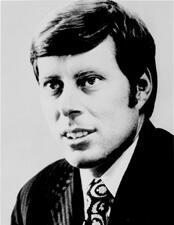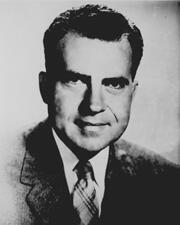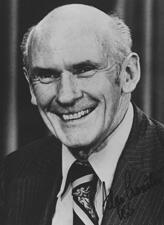
Alan MacGregor Cranston (June 19, 1914 – December 31, 2000) was an American politician, journalist, and advocate of nuclear disarmament who served as a United States Senator from California from January 3, 1969, to January 3, 1993. A member of the Democratic Party, he was elected to four consecutive terms and served as Senate Democratic Whip from 1977 to 1991. Earlier in his career, he served as California State Controller and as president of the World Federalist Association from 1949 to 1952, and later became a prominent international voice for the abolition of nuclear weapons.
Cranston was born in Palo Alto, California, the son of Carol (née Dixon) and William MacGregor Cranston, a family of comfortable means with investments in real estate. He attended Pomona College for one year and spent a summer studying abroad at the National Autonomous University of Mexico before enrolling at Stanford University. He graduated from Stanford in 1936 with a degree in English. An accomplished athlete, he developed a lifelong interest in track and field, later competing as a sprinter in senior races that became part of the emerging sport of masters athletics.
After college, Cranston embarked on a career in journalism. He worked as a correspondent for the International News Service for two years before the United States entered World War II. Disturbed by an abridged English-language edition of Adolf Hitler’s Mein Kampf that he believed had been sanitized to downplay Hitler’s antisemitism and militancy, Cranston produced his own annotated translation intended to reflect the book’s true content. In 1939, Hitler’s publisher sued him for copyright violation in Connecticut; a judge ruled in the publisher’s favor and halted publication, but by then approximately 500,000 copies had been sold, helping to alert a broad American audience to the threat posed by Nazi Germany. Before enlisting in the armed forces in 1944, Cranston worked as an editor and writer for the magazine Common Ground and later for the federal Office of War Information. He enlisted in the U.S. Army as a private in 1944, requested combat duty after completing infantry basic training, but was instead assigned as editor of the Army Talk magazine. While on active duty he wrote The Killing of the Peace, a book summarizing the failed effort to secure U.S. entry into the League of Nations after World War I. He was discharged in 1945 with the rank of sergeant.
Cranston’s wartime experiences and internationalist outlook led him to become a strong supporter of world government. In 1945 he attended the conference that produced the Dublin Declaration, a key document in the early world federalist movement. He organized California chapters of the United World Federalists (UWF) and served as president of the national UWF from 1949 to 1952. During this period he successfully urged the California legislature to adopt the 1949 World Federalist California Resolution, calling on Congress to amend the U.S. Constitution to permit American participation in a federal world government. In the late 1940s he also began what became a lifelong opposition to nuclear weapons. In 1952, he co‑founded the California Democratic Council (CDC), an unofficial coalition of local Democratic clubs that coordinated electoral activities and activism across the state. As chairman, he helped build a grassroots infrastructure that later provided substantial support for his own campaigns for statewide office, including his bid for California State Controller in 1958 and his subsequent runs for the U.S. Senate.
A Democrat, Cranston was elected California State Controller in 1958, becoming the first member of his party to hold that office since John P. Dunn left office in 1891. He was reelected in 1962 but was defeated for reelection in 1966. Cranston first sought a U.S. Senate seat in 1964, running in the Democratic primary but losing to former White House Press Secretary Pierre Salinger, who in turn lost the general election to Republican George Murphy. In 1968, Cranston ran again and was elected to the first of four terms in the United States Senate, defeating Republican state Superintendent of Public Instruction Max Rafferty in the general election after Rafferty had narrowly unseated liberal Republican incumbent Thomas Kuchel in the GOP primary. The 1968 campaign was marred by mudslinging; conservative writer Frank Capell circulated a pamphlet suggesting that Cranston had harbored Communist sympathies in his youth and alleging that, while at the Office of War Information, he had helped mislead President Franklin D. Roosevelt about the Nazi role in the Katyn massacre. Similar allegations resurfaced in a 1974 article in American Opinion titled “Alan Cranston: The Shadow in the Senate,” a reference to the fictional character Lamont Cranston from the radio program The Shadow.
Cranston’s Senate service spanned a significant period in American history, encompassing the Vietnam War, the Cold War détente and its aftermath, and major domestic policy debates. Early in his first term, he introduced a resolution to halt President Richard Nixon’s plan to close 59 Job Corps Centers. He amended the measure to set a June 30 deadline for a congressional study of the targeted facilities and removed language directly criticizing the administration. The Senate Labor and Public Welfare Committee approved the revised proposal by a vote of 10 to 6 in April 1969, but the full Senate defeated it on May 13, 1969, by a vote of 52 to 40. On September 12, 1971, he publicly disputed Pentagon claims that national security would be endangered if Congress failed to renew Nixon’s draft authority and pledged to filibuster the draft extension. In September 1973, he introduced an amendment calling for a 20 percent reduction in American forces stationed overseas within 18 months, including naval forces, as a fallback to Senator Mike Mansfield’s proposal for a 40 percent reduction. During the Watergate era, Cranston announced his support in November 1973 for the nomination of Gerald R. Ford as vice president after consulting hundreds of Californians from both parties and finding little opposition. On April 23, 1974, he charged that Veterans Administration officials had been encouraged to contribute to Nixon’s reelection campaign and that VA Administrator Donald E. Johnson was aware of the activity; a former VA employee corroborated his allegations later that day.
Cranston was reelected to the Senate in 1974, defeating conservative Republican state senator H. L. “Bill” Richardson, a former John Birch Society affiliate, by a margin of 3,693,160 votes (60.5 percent) to 2,210,267 (36.2 percent). In 1977, he was elected Senate Democratic Whip, the second‑ranking position in his party’s leadership, a post he held until 1991. He became a leading voice on arms control and foreign policy, including the debate over the Strategic Arms Limitation Talks (SALT II). In 1979, after 19 senators conditioned their support for the SALT II treaty on assurances about its impact on U.S. defense posture, Cranston acknowledged their concerns as legitimate but noted that most did not relate directly to the treaty’s text and could likely be addressed without “killer amendments.” In March 1981 he joined 23 other elected officials in a joint statement urging the Reagan administration to seek a peaceful resolution to the conflict in Northern Ireland. The following month, in an April 1981 Senate floor speech, he asserted that India and Pakistan were in the final stages of preparing nuclear test sites, predicting that India might test again at Pokhran within months and that Pakistan could produce fissile material for a similar test by late 1981 or 1982. He did not disclose his sources, but senior Reagan administration officials confirmed the general accuracy of his information.
In 1980, Cranston won a third Senate term, defeating Republican tax activist Paul Gann by 4,705,399 votes (56.5 percent) to 3,093,426 (37.1 percent). His 1980 campaign was notable for a July 31 benefit concert that became the final performance by the rock band the Eagles for 14 years; a backstage exchange between band members during the event contributed to their breakup. Cranston’s legislative record reflected a consistently liberal voting pattern. He received a 100 percent rating from the AFL‑CIO in 1969, 1970, 1972, and 1981, with his lowest AFL‑CIO score being 79 percent in 1977. From Americans for Democratic Action, his scores ranged from a low of 72 percent in 1969 to a high of 95 percent in 1982. By contrast, the United States Chamber of Commerce rated him at 0 percent from 1969 to 1973 and again in 1976, underscoring his alignment with labor and progressive causes. In 1986, despite carrying a $2 million debt from his 1984 presidential campaign, he narrowly secured a fourth term by defeating Republican U.S. Representative Ed Zschau in an expensive and closely contested race. On October 2, 1990, he was one of nine senators to vote against the confirmation of David H. Souter as an Associate Justice of the Supreme Court.
Cranston entered the 1984 presidential race as an outspoken critic of the nuclear arms buildup. He became the first announced Democratic candidate on February 1, 1983, and, despite his age—69—and an appearance that some observers thought made him seem older, he quickly gained recognition. His strong advocacy of a bilateral U.S.–Soviet nuclear freeze attracted intense support from anti‑nuclear activists, translating into campaign contributions, committed staff, and volunteers. Among his campaign organizers was future U.S. Senator Maria Cantwell, who moved to Washington State in 1983 to direct his caucus effort there. Cranston won several straw polls in states such as Wisconsin, California, and Alabama. However, the entry of former Senator George McGovern into the race in September 1983 eroded his base. Cranston finished a weak fourth in the Iowa caucuses in February 1984 and, after placing seventh out of eight candidates in the New Hampshire primary with about 2 percent of the vote, he withdrew from the race a week later.
Cranston’s long Senate career was clouded in its final years by his involvement in the savings and loan crisis as one of the “Keating Five.” On November 20, 1991, the U.S. Senate Select Committee on Ethics reprimanded him for “improper conduct” after Lincoln Savings and Loan head Charles Keating’s companies contributed $850,000 to voter registration groups closely affiliated with Cranston. Keating had sought relief from federal regulatory scrutiny of his institution. The Ethics Committee found no evidence that Cranston had explicitly agreed to assist Keating in return for contributions, but nonetheless concluded that his misconduct was the most serious among the five senators involved. Cranston announced in 1991 that he would not seek a fifth term, citing a diagnosis of prostate cancer as his reason for retirement. It was widely believed, however, that the Keating scandal and the resulting damage to his public image were decisive factors; polls suggested he would likely lose a 1992 reelection bid. His successor, Democrat Barbara Boxer, later expressed doubt that he would have stepped down absent the scandal.
Throughout his public life, Cranston remained personally committed to physical fitness and track and field. He regularly trained as a sprinter, often running in long hotel corridors while traveling on political business, and competed in special senior sprint races at major track meets that helped form the early foundation of masters athletics. In his private life, Cranston married and divorced twice. His first wife, Geneva McMath, was the mother of his two sons, Kim and Robin; the elder son, Robin, was killed in a traffic accident in Los Angeles in 1980. Cranston later married Norma Weintraub, who suffered from Parkinson’s disease; the couple divorced in 1989.
After retiring from the Senate in January 1993, Cranston largely withdrew from electoral politics but intensified his work on global peace and nuclear disarmament, causes that had been central to his career since the 1940s. In 1996, he became chairman of the Gorbachev Foundation USA, a San Francisco–based think tank established by former Soviet President Mikhail Gorbachev to promote world peace and arms control. He also served as chairman of the State of the World Forum, where he led efforts for nuclear disarmament through its Nuclear Weapon Elimination Initiative. In 1999, he founded the Global Security Institute, a nonprofit organization dedicated to the worldwide abolition of nuclear weapons, and served as its president. Cranston died of natural causes at his home in Los Altos Hills, California, on December 31, 2000, at the age of 86.
Congressional Record