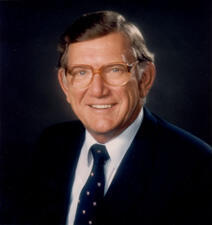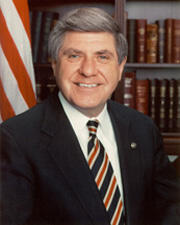
Earl Benjamin Nelson was born on May 17, 1941, in McCook, a small community in southwestern Nebraska. The only child of Birdella and Benjamin Earl Nelson, he was raised in a modest, rural environment that helped shape his pragmatic political outlook. Active in youth organizations, he attained the rank of Eagle Scout, an early indication of his interest in leadership and public service. Growing up in Nebraska during the mid-20th century, Nelson developed a lasting connection to the state’s agricultural communities and small-town culture, influences that would later be reflected in his centrist and often conservative-leaning positions within the Democratic Party.
Nelson pursued higher education at the University of Nebraska–Lincoln, where he completed all of his degrees. He earned a Bachelor of Arts in 1963, followed by a master’s degree in 1965, and then a Juris Doctor in 1970. His legal training provided the foundation for a career that combined law, business, and public policy. Shortly after graduating from law school, he joined Central National Insurance Group of Omaha as assistant general counsel. His work in the insurance industry coincided with a period of growing complexity in financial and regulatory matters, giving him experience that would later inform his approach to state regulation and federal legislation.
Nelson’s early professional career was rooted in insurance and regulatory affairs. In 1975, after several years with Central National Insurance, he was appointed state insurance director by the governor of Nebraska. In that role, he oversaw the regulation of the insurance industry in the state, gaining experience in both executive administration and public oversight. When the gubernatorial administration changed, Nelson returned to Central National Insurance, where he rose through the ranks to become executive vice president and eventually president of the company. During these years he also became more active in Democratic Party politics, reflecting a growing interest in elective office.
By the mid-1980s, Nelson had emerged as a significant figure in Nebraska Democratic politics. In 1986, he served as state chairman of the gubernatorial campaign of Democrat Helen Boosalis, then mayor of Lincoln. Although Boosalis lost to Republican state treasurer Kay Orr by a margin of 53 percent to 47 percent, the campaign increased Nelson’s visibility and experience in statewide politics. Four years later, in 1990, Nelson made his own first run for elective office, challenging Governor Kay Orr. Running as a moderate Democrat in a predominantly Republican state, he narrowly defeated the first-term incumbent by 4,030 votes out of more than 586,000 cast. He was reelected governor in 1994 in a landslide, winning 73 percent of the vote, the largest margin of victory for a Nebraska governor in half a century, despite a national political climate that strongly favored Republicans that year.
As the 37th governor of Nebraska, serving from 1991 to 1999, Nelson pursued a blend of fiscal restraint and selective social policy initiatives that often placed him on the conservative wing of the Democratic Party. He cut spending from the previous administration by 64 percent at a time when it had been forecast to rise by 13 percent, and he enacted tax cuts benefiting more than 400,000 middle-income families. His administration introduced the Safe Streets Act and a Juvenile Crime Bill aimed at cutting crime, and he advocated for low-income families through the creation of the Kids Connection health care system. Nelson also advanced welfare reforms in Nebraska before similar changes were adopted at the national level. On some issues he took positions at odds with national Democratic leaders, notably opposing President Bill Clinton’s health care reform efforts. Environmental and nuclear-waste policy also figured prominently in his tenure: during his 1990 campaign he attacked Orr’s support for a proposed low-level nuclear waste dump in Nebraska, and under his administration the Nebraska Department of Environmental Quality denied the dump’s application for an operating license, leading to litigation that the state ultimately settled for $145 million. In 1996, when Democratic U.S. Senator Jim Exon retired, Nelson ran for the open Senate seat but was defeated in an upset by Republican businessman and Vietnam veteran Chuck Hagel. Term limits prevented Nelson from seeking a third term as governor in 1998, and he left office in January 1999, succeeded by Republican Mike Johanns, then mayor of Lincoln. As of 2026, Nelson remains the last Democrat to serve as governor of Nebraska.
After his gubernatorial service, Nelson turned again to federal office. In 2000, with Democratic Senator Bob Kerrey retiring, Nelson was nominated by the Democratic Party for Nebraska’s other U.S. Senate seat. He faced Republican Attorney General Don Stenberg in the general election. Nelson won with 51 percent of the vote after a campaign in which he spent roughly 50 percent more than his opponent, expending $1,004,985 to secure the seat. Despite an initial public pledge to work closely together, Nelson and fellow Nebraska Senator Chuck Hagel developed a somewhat frosty relationship. Nelson took office on January 3, 2001, beginning the first of his two terms as a United States Senator from Nebraska. He was reelected in 2006, defeating Republican nominee Pete Ricketts, a former TD Ameritrade executive, by a margin of 64 percent to 36 percent. That victory was the largest for a Democratic Senate candidate in Nebraska since Edward Zorinsky’s 66 percent in 1982. In the 2006 race, Nelson drew support from a broad cross-section of the electorate, winning the votes of 42 percent of Republicans, 73 percent of independents, and 96 percent of Democrats, and carrying all but 13 counties in the heavily Republican western part of the state. His 2006 campaign was notable for endorsements from a range of conservative-leaning groups, including the National Rifle Association of America, Nebraska Right to Life, Nebraskans United for Life, the U.S. Chamber of Commerce, the National Federation of Independent Business, the Nebraska Farmers Union PAC, the National Farmers Union PAC, the Veterans of Foreign Wars PAC, the Business-Industry Political Action Committee, and the Omaha Police Union.
During his Senate career, which lasted from January 3, 2001, to January 3, 2013, Nelson developed a reputation as the most conservative Democrat in the chamber, frequently voting against his party’s leadership on high-profile issues. He was firmly anti-abortion and initially enjoyed the backing of Nebraska Right to Life and Nebraskans United for Life, though he later lost that support. On judicial nominations, he played a central role in efforts to avoid partisan escalation. Nelson was the lead Democratic senator in the bipartisan “Gang of 14,” a group of senators who on May 23, 2005, forged a compromise over the use of the filibuster for judicial nominees, thereby blocking Republican leaders from invoking the so-called “nuclear option” to end judicial filibusters. Under the agreement, Democrats retained the right to filibuster judicial nominees only in “extraordinary circumstances,” while three of President George W. Bush’s most conservative appellate court nominees—Janice Rogers Brown, Priscilla Owen, and William Pryor—were guaranteed up-or-down votes. Nelson was the only Democrat to vote to confirm Brown, and he later became the first Democratic senator to support Samuel Alito’s confirmation to the U.S. Supreme Court. He also twice joined three other Democrats in voting to end debate on Bush’s nomination of John Bolton as U.S. Ambassador to the United Nations. In an op-ed, Nelson argued that presidents’ nominees, especially to the Supreme Court, deserved an up-or-down vote even when opposed by special interest groups. In 2010, however, he broke with most of his party by voting against President Barack Obama’s Supreme Court nominee Elena Kagan, citing concerns from Nebraskans and her lack of a judicial record.
Nelson’s conservative positions extended to social issues. In 1996, while still governor, he had proposed and supported legislation to prevent Nebraska from recognizing same-sex marriages performed in other states, responding to a court case in Hawaii that he feared might lead to the legalization of same-sex marriage. He also supported Initiative 416, a constitutional amendment in Nebraska that prohibited same-sex marriage and domestic partnership. In the Senate, he continued to chart an independent course on national security and foreign policy. On March 15, 2007, he was one of only two Democratic senators to vote against invoking cloture on a resolution aimed at withdrawing most American combat troops from Iraq in 2008, a measure that failed on a 50–48 vote, short of the 60 votes required. After traveling to Iraq four times, most recently in September 2007, Nelson argued for a transition of the U.S. mission rather than a rapid withdrawal, emphasizing the need for political reconciliation and strengthened Iraqi security forces. Along with Senators Susan Collins of Maine and John Warner of Virginia, he helped craft a set of “benchmarks” in the Iraq Supplemental bill to measure progress in areas such as minority rights, internal security, and equitable distribution of oil revenues, requiring President George W. Bush and General David Petraeus to report on their implementation. Nelson and Collins also introduced legislation on July 11, 2007, calling for the transfer of internal security responsibilities in Baghdad to Iraqi forces while U.S. troops focused on border security, infrastructure protection, and counterterrorism operations against al-Qaeda.
Nelson’s Senate tenure was also marked by controversy over federal spending and health care reform. In July 2007, Senator Tom Coburn of Oklahoma criticized earmarks Nelson had inserted into the 2007 defense spending bill, alleging that they would benefit the employer of Nelson’s son Patrick by channeling millions of federal dollars to the firm and potentially violating the Federal Funding Accountability and Transparency Act of 2006. Nelson’s office denied any wrongdoing and, acting “with an abundance of caution,” withdrew the amendment after new Senate ethics rules were adopted. Government watchdog groups such as Public Citizen suggested the earmark likely did not violate ethics standards, and some commentators questioned Coburn’s motives, noting that he did not subject his own state’s delegation to similar scrutiny. The most consequential episode of Nelson’s Senate career came during the debate over the Affordable Care Act in 2009 and 2010. In late 2009, with all 40 Senate Republicans opposed to the bill, Democrats needed all 58 of their members plus two independents to invoke cloture and overcome a filibuster. Nelson, who insisted that the final law must prevent the use of public funds for abortions, became the 60th and decisive vote for cloture after the bill was amended to allow states to opt out of abortion coverage in insurance exchange plans and to require separate payments for abortion coverage. The legislation also included a provision granting Nebraska full and permanent federal reimbursement for the costs of expanding Medicaid eligibility, estimated by the Congressional Budget Office at $100 million. Critics labeled this arrangement the “Cornhusker Kickback,” and it drew opposition from Nebraska’s Republican governor, Dave Heineman. Nelson responded that he was attempting to eliminate an unfunded federal mandate on the states and described the Nebraska-specific language as a placeholder intended to be replaced by a nationwide provision. The controversy, however, severely damaged his standing at home: Nebraska Right to Life announced in April 2010 that it would never again endorse him, and polls showed his approval rating dropping from 78 percent to 42 percent. A December 2009 Rasmussen poll found that in a hypothetical race against Heineman, Nelson would receive only 30 percent of the vote to the governor’s 61 percent, and 64 percent of surveyed Nebraskans opposed the health care bill. When Democrats later used the budget reconciliation process to pass the Health Care and Education Reconciliation Act of 2010, which was not subject to filibuster, Nelson voted against the final package, citing new student loan provisions that he believed would harm Nebraska-based student lender Nelnet. The reconciliation bill eliminated the special Medicaid reimbursement for Nebraska, consistent with a request Nelson had made in a letter to Senate Majority Leader Harry Reid about a month after his cloture vote. Although he opposed the reconciliation measure, Nelson continued to defend the Affordable Care Act itself, stating that he was willing to work to improve the law but not to repeal it.
By the end of his second term, Nelson’s centrist record and his role in the health care debate had left him politically vulnerable in a strongly Republican state. In December 2011 he announced that he would not seek a third term in the Senate. He completed his service on January 3, 2013, and was succeeded by Republican Deb Fischer. His departure marked the end of a long period in which Democrats had intermittently held statewide office in Nebraska; as of 2026, Nelson is the last Democrat to have won or held any statewide office in the state. Throughout his career—as an insurance executive, state insurance director, two-term governor, and two-term U.S. senator—Ben Nelson was known for his cautious, incremental approach to policy, his willingness to break with his party on key issues, and his efforts to represent the conservative-leaning electorate of Nebraska within the broader framework of the Democratic Party.
Congressional Record