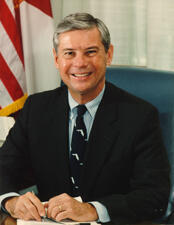
Daniel Robert “Bob” Graham (November 9, 1936 – April 16, 2024) was an American politician and lawyer who served as the 38th governor of Florida from 1979 to 1987 and as a United States Senator from Florida from 1987 to 2005. A member of the Democratic Party, he was a prominent figure in Florida and national politics for more than three decades, contributing to the legislative process during three terms in the Senate and playing key roles in intelligence oversight, environmental policy, and public service education.
Graham was born in Coral Gables, Florida, into a family active in business and civic life. He attended public schools in Florida before enrolling at the University of Florida, where he earned a bachelor’s degree in political science in 1959. At the University of Florida he was involved in student leadership and campus affairs, experiences that helped shape his interest in public life. He went on to study law at Harvard Law School, receiving his law degree before returning to Florida to begin a career that combined law, business, and politics.
After graduating from Harvard Law School, Graham entered elective office in the Florida House of Representatives, marking the beginning of his public career. He subsequently served in both houses of the Florida Legislature, gaining experience in state policy and committee work, including service on the Education Committee. His legislative work helped build a reputation as a diligent, detail-oriented lawmaker. In 1974, while on the Education Committee, he accepted a challenge from Miami teacher M. Sue Riley to gain firsthand experience in education by teaching a semester of civics at Miami Carol City Senior High School, an episode that helped inspire his later “workday” political trademark.
Graham was elected governor of Florida in 1978 and took office as the state’s 38th governor in January 1979. He was reelected in 1982 and served until 1987. As governor, he became widely known for his “workdays,” during which he spent full eight-hour days working in ordinary jobs across the state—such as bellhop, tomato picker, and road construction paver—to better understand the lives of his constituents. Beginning in 1977 and continuing through his gubernatorial campaigns and tenure, he conducted 100 workdays to launch his first gubernatorial bid and ultimately performed more than 400 such workdays over his political career. He insisted on working full shifts, performing all aspects of the job, and often kept the press at a distance to preserve the authenticity of the experience. His gubernatorial years were marked by attention to education, growth management, and environmental protection, and they established him as a moderate, pragmatic Democrat with statewide appeal.
In 1986, Graham ran for the United States Senate and defeated incumbent Republican Senator Paula Hawkins in the general election. He took office on January 3, 1987, and served three consecutive terms, remaining in the Senate until January 3, 2005. As a Senator from Florida, he represented his constituents during a significant period in American history, including the end of the Cold War, the Gulf War, the economic and political shifts of the 1990s, and the post–September 11 era. He helped found the Democratic Leadership Council, a centrist Democratic organization that sought to reposition the party nationally. In the Senate, he developed a reputation for careful preparation, bipartisan cooperation on many issues, and a strong interest in national security, fiscal policy, and environmental and infrastructure concerns important to Florida.
Graham served for ten years on the United States Senate Select Committee on Intelligence and became its chair during and after the September 11, 2001, terrorist attacks and in the run-up to the Iraq War. In that capacity, he led the joint congressional investigation into the 9/11 attacks and emerged as a prominent critic of aspects of U.S. intelligence and foreign policy. He opposed the War in Iraq and was one of 23 senators to vote against President George W. Bush’s request for authorization to use military force, stating after reviewing a National Intelligence Estimate in 2002 that he felt policymakers were being manipulated and that the conflict would distract from confronting the nation’s real enemies. He continued to argue that the Iraq War would have damaging consequences, later saying that it would come to “a bad end in Iraq and an even worse end in Afghanistan.” During his Senate career he also focused on domestic issues, including education, transportation, and environmental protection, and he was known for his meticulous personal record-keeping, maintaining color‑coded notebooks in which he logged his daily activities in great detail. These notebooks, which drew public attention during his consideration as a potential vice-presidential candidate in 2003, were later housed at the University of Florida library.
In December 2002, Graham announced his candidacy for the Democratic nomination for President of the United States in the 2004 election. His campaign emphasized his executive experience as governor, his national security credentials, and his opposition to the Iraq War. After undergoing heart surgery and facing fundraising and organizational challenges, he withdrew from the presidential race in October 2003, before the first primaries. He declined to seek reelection to the Senate in 2004 and retired from the chamber at the end of his third term in January 2005, concluding 18 years of service in the United States Senate.
Following his retirement from Congress, Graham remained active in public affairs, academia, and writing. He spent the 2005–2006 academic year at Harvard University as a fellow at the Institute of Politics, living with his wife among undergraduates in Mather House and leading a weekly study group on effective citizenship. During this period he began work on a book about civic engagement that became America, The Owner’s Manual: Making Government Work for You, published in 2009 and later updated in 2016 as America, The Owner’s Manual: You Can Fight City Hall — And Win, co‑authored with Chris Hand. He returned to his undergraduate alma mater to found the Bob Graham Center for Public Service at the University of Florida, housed within the College of Liberal Arts and Sciences. The center, located in James and Alexis Pugh Hall dedicated in 2008, was created to train future political leaders and provide students opportunities to engage directly with policymakers and scholars.
Graham also played significant roles on national commissions and advisory bodies after leaving the Senate. He co‑chaired the National Commission on the BP Deepwater Horizon Oil Spill and Offshore Drilling, which examined the causes and consequences of the 2010 Gulf of Mexico disaster and recommended reforms to offshore drilling regulation. He served as chairman of the Commission on the Prevention of Weapons of Mass Destruction Proliferation and Terrorism, and through its associated WMD policy center he advocated for the recommendations in its report, “World at Risk.” In addition, he was a member of the Financial Crisis Inquiry Commission, which investigated the causes of the 2007–2008 financial crisis, and served on the CIA External Advisory Board. He was also a member of the Inter-American Dialogue, a Washington-based think tank focused on Western Hemisphere affairs.
An active author, Graham wrote both nonfiction and fiction. In 2004 he published Intelligence Matters: The CIA, the FBI, Saudi Arabia and the Failure of America’s War on Terror, reflecting his experience on the Intelligence Committee and his concerns about counterterrorism policy. His other nonfiction works included Workdays: Finding Florida on the Job, which chronicled his long-running workday practice; World at Risk, related to his WMD commission work; and America: The Owner’s Manual. In 2011 he published his first novel, the political thriller The Keys to the Kingdom, and he later authored an illustrated children’s book, Rhoda the Alligator. Over the years after his Senate retirement he wrote nearly 70 opinion pieces on state and national issues, continuing to influence public debate.
Graham’s health declined after he suffered a stroke in 2020, but he remained a respected elder statesman in Florida and national Democratic politics. He died on April 16, 2024, at a retirement community in Gainesville, Florida, at the age of 87. In recognition of his long service to the state, his body lay in state in Florida’s Historic Capitol before a private family burial.
Congressional Record