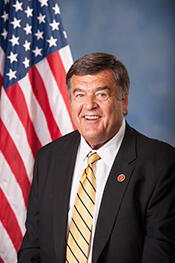
Charles Albert “Dutch” Ruppersberger III (born January 31, 1946) is an American lawyer and politician who served as the U.S. Representative for Maryland’s 2nd congressional district from January 3, 2003, to January 3, 2025. A member of the Democratic Party, he represented a district that includes portions of Baltimore City, Baltimore County, Anne Arundel County, Harford County, and Howard County. Over 11 consecutive terms in the House of Representatives, he contributed to the legislative process during a significant period in American history, participating in the democratic process and representing the interests of his constituents. He announced in January 2024 that he would retire from the United States House of Representatives at the conclusion of the 118th Congress.
Ruppersberger was born in Baltimore, Maryland, the son of Margaret “Peggy” (née Wilson) and Charles Albert “Al” Ruppersberger Jr., and is of part German descent. He grew up in the Baltimore area and attended Baltimore City College, a public college-preparatory high school, graduating in 1963. He went on to attend the University of Maryland, College Park, where he played lacrosse, reflecting an early interest in athletics and teamwork. He later earned his Juris Doctor from the University of Baltimore School of Law, preparing for a career in public service and the law.
Ruppersberger began his professional career as a Baltimore County Assistant State’s Attorney in 1972. In that role, he was soon promoted to chief of the State’s Attorney Office Investigative Division, where he pursued organized crime, political corruption, and drug trafficking cases. His decision to run for public office was influenced by a near-fatal car crash he suffered while investigating a drug trafficking case, an experience that deepened his commitment to public service. He later served as vice chairman on the board of visitors for the hospital that saved his life, underscoring his ongoing engagement with health care and community institutions.
Ruppersberger entered elective office as a member of the Baltimore County Council, to which he was first elected in 1985 and re-elected in 1989. During his tenure on the council, he was twice chosen by his colleagues to serve as council chairman, giving him a leading role in county legislative affairs. In 1994, he was elected Baltimore County Executive and was re-elected in 1998, serving in that post until 2002. As county executive, he oversaw local government operations, budgeting, and public safety in one of Maryland’s most populous jurisdictions, gaining administrative and executive experience that would later inform his work in Congress.
In 2002, Ruppersberger ran for and won election to the U.S. House of Representatives from Maryland’s 2nd congressional district, taking office on January 3, 2003. He became the first Democratic freshman ever appointed to the House Permanent Select Committee on Intelligence, a placement closely tied to the presence of the National Security Agency within his district. From 2011 to 2015, he served as the committee’s ranking member, making him the top Democrat on the panel during the 112th and 113th Congresses and placing him on the elite “Gang of Eight,” the group of congressional leaders by law kept informed of the nation’s most sensitive intelligence activities. In this capacity, he played a central role in intelligence oversight during a period marked by counterterrorism operations, cybersecurity challenges, and debates over surveillance and civil liberties.
During his House tenure, Ruppersberger also served on the powerful Committee on Appropriations, including the Subcommittee on Defense and the Subcommittee on State, Foreign Operations, and Related Programs, where he helped shape federal spending on national defense, diplomacy, and foreign assistance. He participated in numerous caucuses, reflecting a wide range of policy interests, including the Congressional Equality Caucus, the Congressional NextGen 9-1-1 Caucus, the Rare Disease Caucus, the United States Congressional International Conservation Caucus, the U.S.-Japan Caucus, the United States–China Working Group, and the Congressional Caucus on Turkey and Turkish Americans. He was an advocate of municipal finance and tax-exempt municipal bonds; in 2013 he and Representative Randy Hultgren organized a letter signed by 137 House members urging congressional leaders to reject proposals to cap or eliminate the deduction on tax-exempt municipal bonds used to finance local infrastructure. They circulated a similar letter in 2015 and in 2016 formed the Municipal Finance Caucus to protect this financing tool for communities.
Ruppersberger was particularly active on issues of national security, cyber policy, and support for military families. Along with Representative Mike Rogers, he co-sponsored the Cyber Intelligence Sharing and Protection Act (CISPA), designed to increase intelligence sharing between private cybersecurity firms and government agencies. The bill received support from more than 60 businesses and trade organizations, including the U.S. Chamber of Commerce, Time Warner, Verizon, AT&T, IBM, and Intel. Despite amendments intended to address privacy concerns, civil liberties groups such as the Electronic Frontier Foundation criticized the measure for what they viewed as inadequate protections, arguing that it could authorize government surveillance of private communications and allow companies to share large amounts of personal information without a warrant. CISPA passed the House on April 26, 2012, and, after being reintroduced, again passed the House on April 18, 2013, by a bipartisan vote of 288–127, with 92 Democrats, including Ruppersberger, supporting the revised bill.
Beyond intelligence and cybersecurity, Ruppersberger worked on a range of domestic and foreign policy issues. In 2003, he created the national “Hero Miles” program, which allows Americans to donate frequent flyer miles to wounded service members recovering at military or Veterans Administration medical centers, as well as to their friends and family traveling to visit them. In 2012, he authored legislation expanding the initiative to include donated hotel reward points through the “Hotels for Heroes” program. Both programs are administered by the Fisher House Foundation, a nonprofit organization that provides lodging for military families visiting injured loved ones at hospitals across the country. For this work, he received the Charles Dick Medal of Merit in 2004, becoming the last Marylander to win the award, which had previously been awarded to U.S. Representative Beverly Byron (1992), State Senator John Astle (1993), U.S. Senator Barbara Mikulski (1994), U.S. Representative Roscoe Bartlett (1998), and State Delegate Peter Franchot (1999). In October 2017, at the Emergent BioSolutions manufacturing facility in Maryland, he received the Congressional Biosecurity Champion Award from the Alliance for Biosecurity for his leadership in improving U.S. national security, preparedness, and response to biosecurity threats.
Ruppersberger also engaged in debates over U.S. foreign policy and the use of military force. After President Donald Trump ordered an airstrike on Syria in April 2017, he expressed hope that Russia and Iran would join the international community in condemning the use of chemical weapons and called for a broader, thoughtful strategy to address the conflict in Syria, including the defeat of ISIS. In October 2019, he voiced concern about instability in the Middle East and warned that U.S. actions were contributing to increased Russian influence in the region, noting that American troops were expressing concern and embarrassment over leaving behind Kurdish allies. His record on U.S. involvement in Yemen drew attention in December 2018, when The Young Turks reported that he was one of five Democrats who joined most House Republicans to block debate on the war in Yemen and that he had met on multiple occasions with Saudi officials and foreign agents representing them. In February 2019, however, he voted in favor of Representative Ro Khanna’s resolution directing the removal of U.S. armed forces from hostilities in Yemen not authorized by Congress.
Throughout his congressional career, Ruppersberger maintained a focus on social welfare and vulnerable populations. In September 2019, he joined eight other lawmakers in signing a letter to Agriculture Secretary Sonny Perdue urging reconsideration of a proposed rule change that would reduce the number of Americans eligible for Supplemental Nutrition Assistance Program (SNAP) benefits. The letter warned that Maryland’s most vulnerable residents, including children, seniors, and people with disabilities, would suffer “painful consequences of unnecessary and preventable hunger” if the rule were implemented. In addition to his legislative work, he served on the United States Naval Academy Board of Visitors, reflecting his longstanding interest in military affairs and education. After more than two decades in Congress and a prior career in local government and law, he concluded his House service in January 2025 following his previously announced decision to retire at the end of the 118th Congress.
Congressional Record