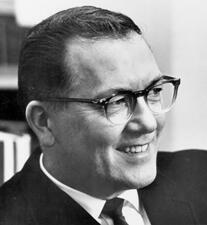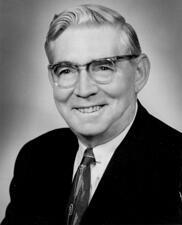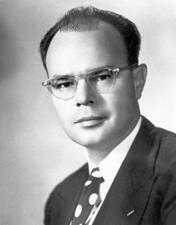
Charles Edward Potter (October 30, 1916 – November 23, 1979) was a U.S. representative and U.S. senator from the state of Michigan. A member of the Republican Party, he served in the United States Congress from 1947 to 1959, contributing to the legislative process during a significant period in American history. Over the course of five terms in office—first in the House of Representatives and then in the Senate—he participated in the democratic process and represented the interests of his Michigan constituents.
Potter was born in Lapeer, Michigan, and attended the public schools there. He went on to Eastern Michigan University in Ypsilanti, Michigan, where he received an A.B. degree in 1938. Shortly after graduating, he entered public service at the local level, working as an administrator for the Bureau of Social Aid in Cheboygan County, Michigan, from 1938 to 1942. These early positions in social welfare administration provided him with experience in public policy and the challenges facing working families in his home state.
In 1942, during World War II, Potter enlisted as a private in the United States Army. He served in the European Theater of Operations with the U.S. 28th Infantry Division and saw extensive combat. In 1945 he was seriously wounded at Colmar, in Alsace, France, an injury that resulted in the loss of both legs. Despite these grievous wounds, he rose to the rank of major and was discharged from the service in 1946. For his valor and sacrifice, he was awarded the Silver Star twice, the French Croix de Guerre, and the U.S. Purple Heart. After leaving the Army, he continued his commitment to veterans and workers as a vocational rehabilitation representative for the Retraining and Reemployment Administration of the U.S. Department of Labor, a position he held until his resignation in 1947.
Potter entered national politics later that year. On August 26, 1947, he was elected as a Republican to the United States House of Representatives from Michigan’s 11th congressional district for the 80th Congress, filling the vacancy caused by the death of Representative Fred Bradley. He was reelected to the two succeeding Congresses and served in the House from August 26, 1947, until his resignation on November 4, 1952. His service in the House coincided with the early Cold War era, when issues of national security, veterans’ affairs, and postwar economic adjustment were central concerns. During this period, he also became involved in the broader congressional effort to address internal security and foreign policy challenges, including those related to the emerging conflict in Korea and the domestic debate over communism.
In 1952, Potter was elected to the United States Senate from Michigan to fill the vacancy caused by the death of Senator Arthur H. Vandenberg, replacing Blair Moody, who had been appointed to the post. He took office on November 5, 1952, to serve the remainder of Vandenberg’s term, which ended on January 3, 1953. In the same election, he was also chosen for the full six-year term commencing January 3, 1953, again defeating Moody. Potter served in the Senate until January 3, 1959, when he left office after being defeated for reelection in 1958 by Democrat Philip Hart. His Senate tenure spanned the administration of President Dwight D. Eisenhower and the height of the Cold War. He was the only member of the Senate Subcommittee on Korean War Atrocities, where he investigated war crimes committed during the Korean War, reflecting his continued engagement with military and veterans’ issues. In domestic policy, he voted in favor of the Civil Rights Act of 1957, supporting landmark federal civil rights legislation during a formative period in the modern civil rights movement.
After leaving Congress in 1959, Potter pursued a career in the private sector as an industrial consultant and international securities executive. He remained engaged in public affairs and Republican Party politics, and he was regarded as a close confidant of President Eisenhower on matters including the response to Senator Joseph R. McCarthy and the broader struggle between moderate Republicans and Democrats over the direction of anti-communist policy. In 1965, he published a memoir, “Days of Shame,” in which he outlined the internal battles in Congress and within his party over McCarthyism and the protection of civil liberties during the Red Scare.
Potter was active in civic, veterans’, and fraternal organizations throughout his life. A Methodist by faith, he was a member of the American Legion, Amvets, Disabled American Veterans, Veterans of Foreign Wars, the Fraternal Order of Eagles, the Benevolent and Protective Order of Elks, Kiwanis, and the American Battle Monuments Commission. In his later years, he resided in Queenstown, Maryland. He died at Walter Reed Army Hospital in Washington, D.C., on November 23, 1979, at the age of sixty-three. Charles E. Potter is interred in Section 30 of Arlington National Cemetery in Fort Myer, Virginia, where his military and public service are commemorated.
Congressional Record