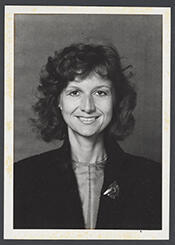
Claudine Schneider (née Cmarada; born March 25, 1947) is an American politician, environmental policy leader, and business executive who served five terms as a Republican U.S. Representative from Rhode Island from January 3, 1981, to January 3, 1991. A member of the Republican Party, she represented Rhode Island’s 2nd congressional district and was the first, and to date only, woman elected to Congress from Rhode Island. During her decade in the House of Representatives, she contributed actively to the legislative process, particularly in the areas of environmental protection, clean energy policy, and international dialogue, and became known as a leading Republican voice on climate and conservation issues.
Schneider was born Claudine Cmarada in Clairton, Pennsylvania, on March 25, 1947. She was raised in a Slovak American family and attended parochial schools. Seeking a broad liberal arts and international education, she studied at the University of Barcelona in Spain and at Rosemont College in Pennsylvania before completing her undergraduate work at Windham College in Vermont, where she obtained a Bachelor of Arts degree in 1969. She later pursued further study in planning and public policy through the University of Rhode Island’s Program in Community Planning. In 1972 she married Eric Schneider; the couple divorced in 1985.
Before entering elective office, Schneider built a career at the intersection of environmental advocacy, energy policy, and public communication. In 1973 she founded the Rhode Island Committee on Energy, reflecting an early and sustained interest in energy efficiency and conservation. The following year, in 1974, she was appointed executive director of the Conservation Law Foundation, a regional environmental organization. By 1978 she had become the federal coordinator of the Rhode Island Coastal Zone Management Program, working on coastal and marine resource issues. From 1978 to 1979 she also worked as a producer and host of a public affairs television program in Providence, Rhode Island, gaining experience in media and public outreach that would later inform her work in Congress.
Schneider was elected as a Republican to the 97th Congress and was re-elected to the four succeeding Congresses, serving from January 3, 1981, to January 3, 1991. Her service in Congress occurred during a significant period in American history, spanning the Reagan and George H. W. Bush administrations, and she participated fully in the democratic process while representing the interests of her Rhode Island constituents. As a freshman Member of Congress in 1981, she quickly established herself as an independent-minded legislator by leading a bipartisan House coalition, together with an unusual alliance of conservative groups and environmental organizations, in opposition to the proposed Clinch River Breeder Reactor project during debate in the House Science Committee. On the House floor she denounced the project as a costly “boondoggle” driven by corporate special interests and posing an undue burden on taxpayers.
Throughout her congressional career, Schneider’s hallmark legislative initiatives centered on promoting clean energy, especially energy efficiency, and on preventing global warming through federal action and international cooperation. Her most ambitious effort in this area was the 1989 Global Warming Prevention Act, which set a goal of reducing atmospheric carbon dioxide levels by 20 percent from 1988 levels by the year 2000 through a coordinated mix of federal and state energy policies. The comprehensive, revenue-neutral omnibus bill attracted bipartisan support from 144 Members of Congress. Although it did not pass in its entirety, two of its titles were later incorporated into federal energy regulatory policy: Title II helped lay the groundwork for the nation’s first appliance energy efficiency standards, which evolved into the Energy Star program, and Title I advanced the concept of least-cost electric utility planning, encouraging utilities to invest in efficiency as an alternative to new generation.
Schneider was also active on fisheries, hazardous waste, and marine protection issues. In 1984 she introduced legislation to halt all fishing for striped bass along the U.S. Atlantic coast for three years to protect rapidly dwindling stocks of this popular sport fish. Her bill initiated the legislative process that led to the Atlantic Striped Bass Conservation Act of 1984, often cited as an example of the successes that can be achieved when state and federal agencies and Congress work together to rebuild coastal fisheries. A longtime advocate of hazardous waste prevention, she was responsible in 1985 for creating the first economic incentive to reduce hazardous waste production through a “waste-end” tax, which was endorsed by the White House and included in the House version of the Superfund reauthorization bill. She was the prime Republican House sponsor of the Ocean Dumping Ban Act of 1988, which prohibited the dumping of sewage sludge and industrial waste into the ocean after 1991. That same year she sponsored legislation requiring U.S. cooperation with foreign countries on biodiversity and environmental protection; President Ronald Reagan signed this measure into law on October 25, 1988.
Beyond environmental and energy policy, Schneider worked to strengthen American economic competitiveness and international understanding. In 1987 she co-founded the Congressional Competitiveness Caucus, working closely with Hewlett-Packard chief executive officer John Young to bring leading corporate executives to Capitol Hill for briefings and discussions with lawmakers. Her work in this area was later recognized when President Bill Clinton appointed her in 1994 to the Competitiveness Policy Council, a federal advisory body focused on long-term economic strategy. In 1986 she organized a series of televised debates and exchanges between Members of Congress and members of the Soviet parliament (the Supreme Soviet) via satellite link between Washington and Moscow. Initially called “CongressBridge,” the initiative sought to break what she and her colleague Representative George Brown described as the 27-year public silence between Soviet and American politicians since the 1959 “kitchen debate” between Vice President Richard Nixon and Soviet Premier Nikita Khrushchev. The series aired in the United States on ABC in 1987 under the title “Capital to Capital,” and Schneider received an Emmy Award for her role in initiating and co-producing these live, unedited programs with journalist Peter Jennings. Among those who worked on her congressional staff were future environmental and energy leaders such as Ian Bowles, later Massachusetts Secretary of Energy and Environmental Affairs, and Michael P. Totten.
In 1990 Schneider chose not to seek re-election to the House and instead ran for the U.S. Senate from Rhode Island in the concurrent election. She was the Republican nominee against long-time Democratic incumbent Senator Claiborne Pell. In the general election she was defeated, receiving 38.2 percent of the vote to Pell’s 61.8 percent. With the end of her House service on January 3, 1991, she concluded a decade in Congress marked by bipartisan environmental initiatives, energy policy innovation, and efforts to foster dialogue across ideological and national boundaries.
After leaving Congress, Schneider continued to work at the nexus of public policy, academia, and private-sector innovation in clean energy. She joined the faculty of the John F. Kennedy School of Government at Harvard University, where she drew on her legislative experience to teach and advise on public policy and leadership. In 1992 she co-founded Energia Global, an international energy efficiency and renewable energy development company that established a major joint venture in Costa Rica. Under its strategy, Costa Rica became one of a small number of nearly carbon-neutral countries. Following a planned ten-year exit strategy, Energia Global was sold to ERGA, then the world’s largest producer of energy from renewable sources. Schneider later moved to Colorado and became senior vice president of Econergy International, a multi-service energy and carbon markets consultancy and owner-operator of renewable energy projects throughout the Americas.
In her post-congressional career, Schneider also worked extensively with corporations, governments, and nonprofit organizations on climate and sustainability initiatives. She helped enlist 50 Fortune 500 corporations—including Raytheon, Bank of America, Target, and Tiffany & Co.—as partners in the U.S. Environmental Protection Agency’s Climate Leaders Program, leading to her nomination by EPA as a “Climate Leader.” She has served on the boards of various companies and advocacy groups, and her consulting clients have included National Grid and other utilities, the U.S. Environmental Protection Agency, the U.S. Department of Energy, Costa Rica’s National Biodiversity Institute (INBio), the Policy Center for Marine Biosciences and Technology, Wheelabrator Technologies, the Smithsonian Institution, and the U.S. Air Force. Her consulting work has focused on strategic planning, futures-scenario design, policy development and implementation, organizational development, ecological economics, lobbying, marketing, and communications. She has delivered keynote speeches at events around the world, sometimes in French or Spanish, and has contributed to numerous journals and books, including the Oxford University Press volume “The Planetary Interest,” in which she was the only American former elected official invited to contribute and was commissioned to address the theme of “consumption.”
Schneider has remained active in public affairs and intra-party reform efforts. She is the founder of Republicans for Integrity, a network of Republican former Members of Congress that describes itself as seeking to remind Republican voters about the fundamentals of the Republican Party and to provide factual information about incumbents’ voting records. In 2023 she was one of six petitioners represented by Citizens for Responsibility and Ethics in Washington in Trump v. Anderson, a case before the Colorado Supreme Court that challenged former President Donald Trump’s eligibility for the 2024 presidential election under the insurrection clause of the Fourteenth Amendment to the United States Constitution. The Colorado Supreme Court ruled Trump ineligible, but the decision was subsequently reversed by the United States Supreme Court. Throughout her career in and out of office, Schneider has been closely identified with environmental stewardship, clean energy innovation, and efforts to uphold ethical standards and democratic norms within her party and the broader political system.
Congressional Record