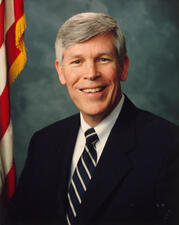
Cornelius Alexander McGillicuddy III, known professionally as Connie Mack III, was born on October 29, 1940, in Philadelphia, Pennsylvania, the son of Cornelius Alexander McGillicuddy Jr. and Susan (née Sheppard) McGillicuddy. He was born into a prominent family with deep roots in both American politics and professional baseball. His paternal grandfather was Connie Mack (1862–1956), the famed owner and manager of baseball’s Philadelphia Athletics and a member of the Baseball Hall of Fame. On his mother’s side, Mack was the grandson of Morris Sheppard, who served as both a United States Senator and Representative from Texas, and the step-grandson of Tom Connally, who also served as a United States Senator from Texas following his marriage to Mack’s widowed grandmother after Sheppard’s death. His maternal great-grandfather, John Levi Sheppard, was a U.S. Representative from Texas. Mack’s father’s line were Irish immigrants. These intertwined political and sporting legacies contributed to the perception of “the Macks” as one of the notable political dynasties in the United States.
Mack was educated in Florida and went on to attend the University of Florida, where he graduated with a Bachelor of Business Administration (B.B.A.) degree in 1966. During his time at the university he was active in campus life and became a member of the Sigma Alpha Epsilon fraternity and Florida Blue Key, a prestigious leadership and service organization. His early professional life was spent outside elective office, but his family background and business training laid the groundwork for his later career in public service and national politics.
Connie Mack made his first run for public office in 1982, seeking election to the United States House of Representatives from Florida’s newly created 13th congressional district, a Gulf Coast district stretching from Sarasota to Naples. The previous 13th District, represented by Democrat William Lehman, had been renumbered as the 17th District, leaving an open seat. In a crowded four-way Republican primary, Mack led the field with 28 percent of the vote and then won the October runoff against State Representative Ted Ewing by a margin of 58 to 42 percent. In the November 1982 general election he prevailed with 65 percent of the vote, beginning his federal legislative career. He was reelected without opposition in 1984 and again in 1986 with 75 percent of the vote, serving in the House from January 3, 1983, to January 3, 1989, as the representative of Florida’s 13th congressional district. During this period, he established himself as a Republican voice on fiscal and health policy issues and built a reputation that would support his later statewide campaigns.
After three terms in the House, Mack sought higher office when incumbent Democratic U.S. Senator Lawton Chiles decided to retire. In 1988, Mack entered the Republican primary for the U.S. Senate from Florida and won decisively with 62 percent of the vote against Robert Merkle. In the general election he faced Democratic U.S. Representative Buddy MacKay and was elected to the Senate with 50 percent of the vote, beginning his Senate service on January 3, 1989. A member of the Republican Party, Connie Mack served as a United States Senator from Florida from 1989 to 2001, following his earlier House service from 1983 to 1989, thus serving in Congress during a significant period in American history. He was reelected to the Senate in 1994, defeating Democratic attorney Hugh Rodham, the brother of Hillary Clinton, by a landslide margin of 71 to 29 percent and carrying every county in the state. With this victory, he became the only Republican Senator in Florida history to be elected to more than one term until Marco Rubio achieved reelection in 2016. During his Senate tenure, he rose in the party leadership and served as chairman of the Senate Republican Conference from 1997 to 2001, one of the top leadership posts among Senate Republicans.
Throughout his congressional career, Mack participated actively in the legislative process and represented the interests of his Florida constituents while also taking on national policy issues. He supported the passage of laws dealing with health care, fiscal policies, modification of the federal tax code, and public housing reform. A cancer survivor himself, he became a prominent advocate for cancer research, early detection, and treatment. Mack led a bipartisan congressional effort to double funding for biomedical research at the National Institutes of Health and worked to secure the necessary appropriations to implement that expansion. He played a key role in securing Medicare coverage for clinical trials and was a leading Republican advocate of the Women’s Health Initiative. He also worked to strengthen and reform the U.S. Food and Drug Administration, reflecting his broader interest in health policy and regulatory oversight. For his efforts in the field of cancer research and advocacy, Mack received the American Cancer Society’s Courage Award and the Susan G. Komen Breast Cancer Foundation’s Betty Ford Award in 1992, and in 1999 he was honored with the National Coalition for Cancer Research Lifetime Achievement Award.
Mack’s stature within the Republican Party extended beyond his formal leadership role in the Senate. He was twice considered as a potential Republican vice-presidential nominee: by Senator Bob Dole in 1996 and by Governor George W. Bush in 2000, reflecting his prominence as a Southern Republican with legislative experience and a reputation for policy seriousness. After deciding not to seek reelection, Mack retired from the Senate at the end of his second term, leaving office on January 3, 2001. Democrat Bill Nelson, then Florida State Treasurer and a former U.S. Representative, won the open seat in the 2000 election. In a continuation of the family’s political involvement, Mack’s son, U.S. Representative Connie Mack IV, later ran unsuccessfully against Nelson for the same Senate seat in 2012.
Following his retirement from Congress, Connie Mack III remained active in public policy and advisory roles. In 2005, President George W. Bush appointed him chairman of the President’s Advisory Panel for Federal Tax Reform, where he drew on his long-standing interest in fiscal policy and tax-code modification to help develop recommendations for restructuring the federal tax system. Beginning in early 2007, Mack served as Senior Policy Advisor to Liberty Partners of Tallahassee, a Florida-based lobbying and consulting firm, providing strategic advice on governmental and regulatory matters. He also remained engaged in Florida civic and historical projects. In 2005, he was featured in “Castles in the Sun,” a documentary about the development of Cape Coral, Florida. The film highlighted his family’s connection to the region through his father, Connie Mack Jr., who had worked as a public relations representative for Leonard and Jack Rosen, the brothers who developed Cape Coral as a waterfront resort. For the documentary, Connie Mack III was interviewed at his home on Palm Island, Florida, reflecting on both his family’s role in the area’s growth and his own long career in public life.
Congressional Record