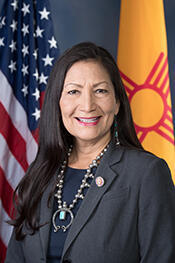
Debra Anne Haaland (born December 2, 1960) is an American politician who served as a Representative from New Mexico in the United States Congress from 2019 to 2021 and as the 54th United States secretary of the interior from 2021 to 2025. A member of the Democratic Party, she represented New Mexico’s 1st congressional district, which includes most of Albuquerque and its suburbs, and earlier served as chair of the New Mexico Democratic Party from 2015 to 2017. Haaland, a Native American, is an enrolled member of the Laguna Pueblo tribe and is widely recognized as one of the first two Native American women elected to the U.S. Congress. Throughout her career she has been identified as a political progressive, supporting policies such as the Green New Deal and Medicare for All.
Haaland was born on December 2, 1960, and is a citizen of the Pueblo of Laguna, with additional ties to the Jemez Pueblo through her heritage. She grew up in a military family; her father was a U.S. Marine and her mother served in the U.S. Navy, experiences that shaped her understanding of public service and the federal government’s relationship with Native communities. Her upbringing in New Mexico, in and around Pueblo communities, grounded her in Indigenous traditions and perspectives that would later inform her political priorities, particularly in the areas of tribal sovereignty, environmental protection, and federal-tribal relations.
Haaland pursued higher education as a nontraditional student, working to support herself and her child while completing her studies. She earned a Bachelor of Arts degree from the University of New Mexico and later received a Juris Doctor from the University of New Mexico School of Law. Her legal training and community involvement led her into Democratic Party politics and tribal advocacy, where she focused on issues such as voting rights, economic opportunity, and the protection of Native lands and cultural resources. These experiences laid the foundation for her later leadership roles within the state party and at the national level.
From 2015 to 2017, Haaland served as chair of the New Mexico Democratic Party. In that role she helped guide the party’s organization, candidate recruitment, and electoral strategy during a period of rebuilding for Democrats in the state. After the expiration of her term as state party chair, she announced her intention to run for the United States House of Representatives in New Mexico’s 1st congressional district in the 2018 elections, seeking to succeed Representative Michelle Lujan Grisham, who was running for governor. In June 2018 she won the Democratic nomination with 40.5 percent of the vote, defeating Damon Martinez and Antoinette Sedillo Lopez and carrying every county in the district. Haaland campaigned as a progressive, emphasizing support for the Green New Deal, Medicare for All, and stronger environmental and tribal protections.
In the November 6, 2018, general election, Haaland defeated former New Mexico state representative Janice Arnold-Jones, receiving 59.1 percent of the vote and winning three of the district’s five counties. Her victory was part of a broader Democratic sweep in New Mexico that year, in which Democrats captured every statewide and federal office on the ballot and expanded their majority in the New Mexico House of Representatives. When she took office in January 2019, Haaland, together with Representative Sharice Davids of Kansas, a member of the Ho-Chunk Nation, became one of the first two Native American women ever elected to and seated in the U.S. Congress. During the swearing-in ceremony, she wore traditional Pueblo dress, a necklace, and moccasins, symbolically bringing Indigenous identity and representation into the House chamber.
Haaland’s service in Congress occurred during a significant period in American history, marked by intense national debates over health care, climate policy, voting rights, and the federal government’s responsibilities to tribal nations. As a member of the House of Representatives from 2019 to 2021, she participated in the democratic process and represented the interests of her constituents in New Mexico’s 1st district. On March 7, 2019, during a debate on voting rights and campaign finance, she became the first Native American woman to preside over the U.S. House of Representatives. During the 116th Congress she co-sponsored more bills than any other freshman member and compiled one of the most liberal voting records, according to contemporaneous reporting. She also served as one of three co-chairs of Senator Elizabeth Warren’s 2020 presidential campaign, reflecting her growing national profile within the Democratic Party. In the November 3, 2020, general election, Haaland was reelected with 58.2 percent of the vote, defeating retired police detective Michelle Garcia Holmes, who had previously run for lieutenant governor of New Mexico in the 2018 gubernatorial election.
Haaland’s public statements occasionally drew national attention. In January 2019, following the widely publicized Lincoln Memorial confrontation involving students from Covington Catholic High School, she said that the students had displayed “blatant hate, disrespect, and intolerance.” A libel lawsuit brought by students of the school, alleging that her words were “false and defaming,” was dismissed on the grounds that her statements were made within the scope of her employment as a legislator. Despite such controversies, she remained a prominent advocate for Indigenous rights, environmental justice, and expanded social programs, and she continued to emphasize the importance of Native representation in federal policymaking.
On December 17, 2020, then president-elect Joe Biden announced that he would nominate Haaland to serve as secretary of the interior. The U.S. Senate confirmed her on March 15, 2021, by a vote of 51–40, with four Republicans—Susan Collins, Lisa Murkowski, Dan Sullivan, and Lindsey Graham—joining Democrats in support. Her departure from the House triggered a special election in New Mexico’s 1st congressional district in 2021. Following her swearing-in on March 16, 2021, she became the first Native American to serve as a Cabinet secretary and the second Native American to serve in the Cabinet, after Republican former vice president and Kaw Nation citizen Charles Curtis. As secretary, she frequently incorporated Indigenous traditions into her public role, often wearing Native jewelry and decorating her office with Native art, and she was sworn in wearing a combination of traditional Laguna Pueblo regalia and a colorful ribbon skirt custom-made by Agnes Woodward.
Haaland’s tenure as secretary of the interior from 2021 to 2025 was marked by a focus on tribal consultation, environmental conservation, and addressing historical injustices affecting Native peoples. On her first day in office she met with tribal media in a press conference organized by the department and the Native American Journalists Association, emphasizing her intention to include tribes in decisions that affected them. In April 2021 she announced the creation of a new Missing and Murdered Unit within the Bureau of Indian Affairs to address the long-standing crisis of missing and murdered Native Americans, stating that the unit would leverage every available resource to prevent cases from becoming cold. In May 2021 she approved a new constitution for the Cherokee Nation that included protections for Cherokee Freedmen. The following month she launched the Federal Indian Boarding School Initiative to investigate abuse in the former federal boarding school system established under the 1819 Civilization Fund Act, later participating in “Road to Healing” events to gather testimony from survivors, including those whose experiences paralleled those of her own grandparents, who had been sent to such schools.
As secretary, Haaland also undertook efforts to reform federal land management and address derogatory place names. In November 2021 she ordered the creation of a task force to recommend new names for approximately 650 geographic features on federally owned lands that used the word “squaw,” a term widely recognized as a slur against Native American women. She played a central role in President Biden’s designation of several national monuments, including Avi Kwa Ame in Nevada, Baaj Nwaavjo I’tah Kukveni – Ancestral Footprints of the Grand Canyon in Arizona, and the Carlisle Indian Industrial School National Monument in Pennsylvania. These designations incorporated Native participation in land management and were framed as part of a broader effort to address historical wrongs and elevate tribal voices in conservation policy. In March 2023 she announced $25 million dedicated to bison conservation, further underscoring her emphasis on restoring culturally significant species and ecosystems. Haaland’s national profile continued to grow, and she spoke at the 2024 Democratic National Convention on August 22, 2024.
After completing her service as secretary of the interior in 2025, Haaland turned her attention back to state-level leadership in New Mexico. On January 28, 2025, she announced that she would run for governor of New Mexico in the 2026 gubernatorial election, seeking to succeed term-limited Governor Michelle Lujan Grisham. She formally kicked off her campaign in Los Alamos before a large audience. Haaland’s candidacy for governor built upon her experience as a former member of Congress, state party chair, and Cabinet secretary, and reflected her continuing engagement in public life and in the political future of New Mexico.
Congressional Record