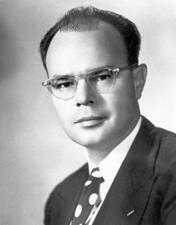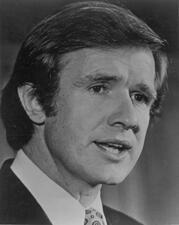
Donald Wayne Riegle Jr. (born February 4, 1938) is an American politician, author, and businessman from Michigan who served for five terms as a United States Representative and for three terms as a United States Senator in the U.S. Congress. A member of the Democratic Party for most of his congressional career, Donald Wayne Riegle served in Congress from 1967 to 1995, contributing to the legislative process during eight terms in office and representing the interests of his Michigan constituents during a significant period in American history.
Riegle was born in Flint, Michigan, to Donald Wayne Riegle Sr. and Dorothy Grace Riegle. His grandfather, John Louis Riegle, owned the Riegle Press and later served as mayor of Flint, giving the family a longstanding connection to local business and public life. He attended Flint Central High School and went on to Flint Junior College (now Mott Community College) and Western Michigan University. He completed his undergraduate education at the University of Michigan–Flint, graduating in 1960 with a bachelor’s degree in business administration and economics.
Following his undergraduate studies, Riegle pursued graduate education in business and finance. He received a Master of Business Administration in finance from Michigan State University in 1961. From 1961 to 1964 he was employed by IBM as a financial analyst, gaining experience in corporate finance and management. Between 1964 and 1966 he completed required coursework for doctoral studies in business and government relations at Harvard Business School before leaving to run for Congress. During this period and afterward, he also taught at several universities, including Michigan State University, Boston University, the University of Southern California, and Harvard University, reflecting an early and sustained engagement with issues at the intersection of business, public policy, and governance.
In 1966, former Vice President Richard Nixon persuaded the 28‑year‑old Riegle, then considered a moderate Republican, to return to Michigan to run for Congress. Nixon attended an early campaign fundraiser and publicly promoted Riegle’s prospects. In the general election, Riegle defeated incumbent Democratic U.S. Representative John C. Mackie of Michigan’s 7th congressional district, one of the so‑called “Michigan Five Fluke Freshmen” who lost their seats after a single term, and entered the 90th Congress in January 1967. Riegle was subsequently reelected to the House of Representatives, ultimately serving five terms. In 1973, amid growing differences with the Nixon administration over the Vietnam War and the “Southern strategy,” he changed his party affiliation from Republican to Democrat. He was reelected as a Democrat to the 94th Congress, solidifying his new partisan alignment. During his House tenure he was an early advocate of consumer and civil rights in credit markets; in 1973 he co‑sponsored H.R. 8163, the Equal Credit Opportunity Act, introduced by Representative Bella Abzug, to prevent discrimination on the basis of sex or marital status in the granting of credit. The bill passed both chambers and was signed into law by President Gerald Ford on October 28, 1974.
Riegle did not seek reelection to the House in 1976, instead announcing his candidacy for the United States Senate to succeed retiring Senator Philip Hart of Michigan. In the Democratic primary he defeated Michigan Secretary of State Richard H. Austin and fellow Congressman James G. O’Hara. In the general election he prevailed over Republican Congressman Marvin L. Esch. Although his six‑year Senate term was scheduled to begin on January 3, 1977, he entered the Senate early when Governor William Milliken appointed him on December 30, 1976, to fill the vacancy created by Senator Hart’s death for the remainder of the term ending January 3, 1977. Riegle was reelected to the Senate in 1982 and again in 1988; his 1988 victory marked the largest Democratic margin of victory in a statewide race in Michigan’s history up to that time, a record later surpassed by Senator Carl Levin in 2008. Over the course of his three Senate terms, he became a prominent figure in financial, banking, health, labor, and technology policy. He did not seek reelection in 1994, concluding his congressional service in January 1995.
During his Senate career, Riegle held several influential committee assignments and chairmanships. He served as chairman of the Senate Committee on Banking, Housing, and Urban Affairs from 1989 to 1995, a period marked by major reforms in banking and financial regulation. He also served on the Senate Committee on Finance, where he chaired the Subcommittee on Health for Families and the Uninsured, focusing on access to health care and coverage issues. On the Senate Committee on Labor and Human Resources, he chaired the Subcommittee on Alcoholism and Drug Abuse, addressing public health and addiction policy. In addition, he served on the Senate Committee on Commerce, Science, and Transportation, chairing the Subcommittee on Science and Space, and was a member of the Senate Committee on the Budget from 1979 to 1995. Through these roles he participated extensively in the democratic process, shaping legislation across a wide range of domestic policy areas.
Riegle played a central role in several landmark financial and banking reforms. In his first major action as chairman of the Senate Banking Committee, he led efforts to address the savings and loan crisis, resulting in the Financial Institutions Reform, Recovery, and Enforcement Act of 1989 (FIRREA). Described as the toughest financial reform bill in fifty years, FIRREA restructured and reformed the savings and loan industry by imposing controls on state‑chartered thrifts, curbing excessive risk‑taking, limiting brokered deposits, banning junk bond investments, and establishing new capital requirements. He subsequently led the effort to enact the Federal Deposit Insurance Corporation Improvement Act of 1991 (FDICIA), which preserved the FDIC’s ability to protect depositors, reformed bank supervision and regulation, restricted the “too big to fail” policy, strengthened regulation of foreign banks operating in the United States, and expanded disclosure requirements for banks to consumers. Riegle also sponsored the Riegle Community Development and Regulatory Improvement Act of 1994, which created the Community Development Financial Institutions Fund to support community development banks and other mission‑driven lenders, enhanced consumer protections for high‑rate home equity loans, included measures to increase credit availability to small businesses, streamlined regulation of depository institutions, and reformed the National Flood Insurance Program. That same year he co‑authored the Riegle–Neal Interstate Banking and Branching Efficiency Act of 1994, which eliminated many restrictions on interstate banking by permitting bank holding companies to acquire banks in any state, allowing banks to merge across state lines unless states opted out, and reducing competitive advantages enjoyed by foreign banks in the U.S. market.
Beyond financial regulation, Riegle used his committee authority to investigate national security and veterans’ health issues. In 1994, as chairman of the Senate Banking Committee, he led an investigation into illnesses experienced by veterans of the Gulf War, using the committee’s jurisdiction over “dual use” exports—materials and technologies with potential military applications. The resulting document, commonly known as the Riegle Report to the U.S. Senate, detailed at least three occasions on which U.S. military forces came into contact with chemical warfare agents that may have contributed to what became known as Gulf War syndrome. The report also asserted that at least some of the biological agents and other materials later associated with Iraqi weapons programs had been provided to Saddam Hussein by the United States. The report called for further government investigation and for recourse and support for veterans suffering from Gulf War–related illnesses.
In addition to his legislative work, Riegle was active as an author and commentator on congressional affairs. In 1972 he co‑authored the best‑selling book “O Congress” with Trevor Armbrister, offering an insider’s account of the workings of Congress, his opposition to the Vietnam War, and his break with the Nixon White House. After leaving the Senate in 1995, he entered the private sector in Washington, D.C., joining Weber Shandwick Public Affairs. There he was instrumental in building the firm’s government affairs practice and played a key role in the acquisition of Powell Tate, a government affairs firm that continued to operate under its own brand within Weber Shandwick. As the company expanded, Riegle assumed increasing responsibilities and ultimately served as deputy chairman. In 2001 he joined APCO Worldwide, another major public affairs and public relations firm, as chairman of government relations in Washington, D.C., continuing his involvement in public policy and advocacy. Remaining engaged in national politics, he endorsed Senator Bernie Sanders for the Democratic nomination for President of the United States in both the 2016 and 2020 election cycles.
Congressional Record