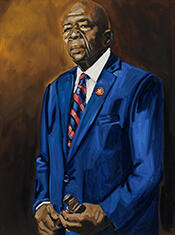
Elijah Eugene Cummings (January 18, 1951 – October 17, 2019) was an American politician and lawyer who served as a Representative from Maryland in the United States Congress from 1996 to 2019. A member of the Democratic Party, he represented Maryland’s 7th congressional district in the U.S. House of Representatives from April 16, 1996, until his death, serving 13 terms in office. The district he represented included over half of the city of Baltimore, including most of the majority-Black precincts of Baltimore County, and most of Howard County, Maryland. Over the course of his career, Cummings became a prominent national figure on issues of civil rights, government oversight, and social justice, and was widely respected by colleagues in both parties.
Cummings was born on January 18, 1951, in Baltimore, Maryland, the son of Ruth Elma (née Cochran) and Robert Cummings, who had been sharecroppers before moving north. He was the third of seven children. Growing up in a working-class, segregated Baltimore neighborhood, he experienced racial discrimination firsthand. At age 11, he and several friends worked to integrate a segregated swimming pool in South Baltimore, an early episode that shaped his lifelong commitment to civil rights and equality. He was raised in a religious household and later became an active member of New Psalmist Baptist Church in Baltimore, where he would remain a member for 40 years.
Cummings graduated with honors from Baltimore City College, a public college-preparatory high school, in 1969. He then attended Howard University in Washington, D.C., where he was deeply involved in student leadership. At Howard, he served in student government as sophomore class president, student government treasurer, and later student government president. He became a member of Phi Beta Kappa and graduated in 1973 with a bachelor’s degree in political science. He went on to study law at the University of Maryland School of Law, earning his Juris Doctor in 1976. That same year he was admitted to the Maryland bar and began practicing law in Baltimore. Cummings practiced law for 19 years before his election to Congress, building a career that focused on advocacy and community issues. He was also a member of Phi Beta Sigma fraternity and a Prince Hall Mason.
Cummings entered elective office in 1983, when he was elected to the Maryland House of Delegates. He served there for 14 years, until 1996. His predecessor in the seat, Delegate Lena King Lee, raised funds and campaigned for him, and Cummings later credited her with launching his political career. In the Maryland General Assembly, he rose to prominence as Chairman of the Legislative Black Caucus of Maryland and became the first African American in Maryland history to be named Speaker Pro Tempore of the House of Delegates. During this period, he was diagnosed in 1994 with a rare form of cancer, thymic carcinoma, while serving as a member of the Maryland House of Delegates, a condition he would live with for 25 years. In addition to his legislative work, he became active on numerous boards and commissions, including the SEED School of Maryland Board of Directors, the University of Maryland School of Law Board of Advisors, the Board of Visitors to the United States Naval Academy, and the Elijah Cummings Youth Program in Israel. He was also an honorary member of the Baltimore Zoo Board of Trustees and wrote a biweekly column for the Baltimore Afro-American newspaper.
Cummings was elected to Congress in 1996 following the resignation of Kweisi Mfume, the five-term Congressman for Maryland’s 7th congressional district, who left office in February 1996 to become president of the NAACP. In a crowded twenty-seven-way Democratic primary in this heavily Democratic, Black-majority district, Cummings won with 37.5 percent of the vote. In the April 16, 1996, special election, he defeated Republican Kenneth Kondner with over 80 percent of the vote, and he defeated Kondner again in the November 1996 general election by a similar margin to win the seat in his own right. He was reelected 11 more times in the contests that followed, never dropping below 69 percent of the vote, and he ran unopposed in 2006. A member of the Congressional Progressive Caucus, he was also active in several issue-based caucuses, including the Task Force on Health Care Reform, the Congressional Arts Caucus, and the Afterschool Caucuses. He co-founded and served as chairman of the Congressional Caucus on Drug Policy and served as chairman of the Congressional Black Caucus during the 108th Congress (2003–2005).
Over the course of his congressional career, Cummings served on the Committee on Transportation and Infrastructure, including its Subcommittee on Coast Guard and Maritime Transportation and Subcommittee on Railroads, Pipelines, and Hazardous Materials. He became best known, however, for his long service on the House Committee on Oversight and Government Reform (later the Committee on Oversight and Reform). Within that committee he served on the Subcommittee on Domestic Policy and the Subcommittee on Federal Workforce, Post Office, and the District of Columbia. In the 114th Congress he served as the ranking minority member on the House Select Committee on Benghazi. In December 2010, after Representative Edolphus Towns announced he would not seek the position of ranking minority member of the Oversight Committee amid concerns from House Democratic leadership and the White House about his aggressiveness in confronting incoming Republican chair Darrell Issa, Cummings was chosen by the House Democratic Caucus over Representative Carolyn Maloney to serve as ranking member. He later became chair of the Committee on Oversight and Reform in January 2019, a position he held until his death in October of that year.
As a legislator, Cummings played a central role in high-profile investigations and in shaping federal records and whistleblower policy. He received national attention during the 2008 congressional hearings on the use of steroids in professional baseball, when he sharply questioned former single-season home run record holder Mark McGwire and pressed him on whether he was “taking the Fifth,” after McGwire repeatedly declined to answer questions about past steroid use, saying he was there “to talk about the future, not about the past.” The exchange became emblematic of the inquiry. Cummings introduced the bipartisan Presidential and Federal Records Act Amendments of 2014, co-sponsored with Representative Darrell Issa, which modernized the Federal Records Act and Presidential Records Act, including by expressly defining electronic documents as federal records; the bill was signed into law by President Barack Obama in December 2014. He supported the Smart Savings Act, which changed the default investment in the federal Thrift Savings Plan from the Government Securities Investment Fund (G Fund) to an age-appropriate L Fund, calling it a “commonsense change” to help workers benefit from diversified, higher-yield investments. He also introduced the All Circuit Review Extension Act, extending for three years the authority for federal employees appealing Merit Systems Protection Board decisions to file in any U.S. circuit court of appeals rather than only the U.S. Court of Appeals for the D.C. Circuit. Cummings argued that this flexibility was vital for whistleblowers, noting that the Federal Circuit had “an abysmal track record in whistleblower cases.” He was a strong supporter of the Affordable Care Act but favored a single-payer healthcare system and believed the law should have included a public option.
Cummings’s leadership on the Oversight Committee became especially prominent during the Trump administration. As chair, he presided over the first public testimony by President Donald Trump’s former personal attorney, Michael Cohen, in February 2019, and he emerged as a leading figure in the House’s impeachment-related investigations of the administration. Following his death, Speaker Nancy Pelosi named Carolyn Maloney acting chair of the Oversight Committee; she subsequently won election in the Democratic Caucus to serve as permanent chair. Earlier, during the 2008 and 2012 election cycles, Cummings had been an early and active supporter of Barack Obama’s presidential campaigns. Beginning in early 2007, he campaigned extensively to build Obama’s support in the African American community at a time when Obama remained relatively unknown and Congressional Black Caucus support was divided between Obama and Hillary Clinton. At the 2016 Democratic National Convention, Cummings underscored his civil rights commitments, declaring, “Our party does not just believe, but understands, that Black Lives Matter. But we also recognize that our community and our law enforcement work best when they work together.”
Outside his formal legislative duties, Cummings was deeply involved in civic and educational initiatives and was known for his oratory and emotional engagement with public issues. He frequently delivered speeches marked by visible passion and could often be seen becoming emotional in public as he spoke about justice, opportunity, and the struggles of his constituents. Colleagues from both parties described him as highly personable and agreeable; he often befriended Republican members and was widely respected across the aisle for his fairness and integrity. In addition to his work on boards and commissions, he maintained a strong presence in Baltimore civic life and continued to write and speak regularly on public affairs.
Cummings’s personal life was closely tied to Baltimore. He lived in the Madison Park community of the city and was an active member of New Psalmist Baptist Church. He married Joyce Matthews, with whom he had a daughter, Jennifer J. Cummings. He also had a son and another daughter, Adia Cummings, from other relationships. In 2009 he married Maya Rockeymoore, a policy consultant and political strategist who was elected chairwoman of the Maryland Democratic Party in December 2018. His family experienced tragedy in June 2011 when his nephew Christopher Cummings, the son of his brother James, was murdered at his off-campus house near Old Dominion University in Norfolk, Virginia, where he was a student; on August 12, 2021, Norfolk police charged four men with the murder. Cummings’s own health challenges intensified in his later years. In May 2017 he underwent surgery to repair his aortic valve and was absent from Capitol Hill for two months. He developed a surgery-related infection in July 2017 but returned to work, and he was later hospitalized for a knee infection. It was revealed in November 2019 that he had lived with thymic carcinoma since 1994, although this was not publicly identified as the cause of his death.
Elijah Cummings died on October 17, 2019, at Johns Hopkins Hospital in Baltimore at the age of 68 from “complications concerning longstanding health challenges,” according to his spokeswoman. His passing marked the end of more than three decades in elected office and 13 terms in the U.S. House of Representatives. On October 24, 2019, he became the first African American lawmaker to lie in state at the U.S. Capitol, where his casket was placed in Statuary Hall. Prior to him, the most recent individuals to lie in state had been former Senator John McCain and former President George H. W. Bush. Thousands of mourners, including members of Congress and members of the public, came to pay their respects and were greeted by his widow, Maya Rockeymoore Cummings, before his casket departed the Capitol that evening. On October 25, 2019, an official funeral service was held at New Psalmist Baptist Church in Baltimore. The service was attended by numerous national political figures, including former Presidents Barack Obama and Bill Clinton, former Secretary of State Hillary Clinton, House Speaker Nancy Pelosi, then–former Vice President Joe Biden, Representative John Lewis, and Senators Amy Klobuchar and Elizabeth Warren, as well as Representative Alexandria Ocasio-Cortez and his predecessor and eventual successor, Kweisi Mfume. His longtime pastor and friend, Bishop Walter S. Thomas Sr., delivered the eulogy, honoring Cummings’s life of public service and his enduring commitment to justice and his constituents.
Congressional Record