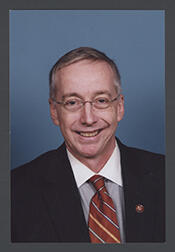
Geoffrey Clark Davis (born October 26, 1958) is an American businessman, politician, and former U.S. Representative for Kentucky’s 4th congressional district, serving from January 3, 2005, until his resignation on July 31, 2012. A member of the Republican Party, he represented a district that included 24 counties in the northeastern part of Kentucky, stretching from the fringes of the Louisville metropolitan area to the West Virginia border, with most of its vote concentrated in the suburban counties bordering Cincinnati, Ohio. During his four terms in the United States House of Representatives, Davis contributed to the legislative process at a time of significant national debates over foreign policy, national security, and federal regulation.
Davis was born in Montreal, Quebec, Canada, to American parents. He was raised in the United States and, after graduating from high school, enlisted in the United States Army. His early military service led to an appointment to the United States Military Academy at West Point, where he studied national security and international affairs and undertook coursework in the Arabic language. This academic and military training laid the foundation for a career focused on defense, aviation, and international security issues.
Following his graduation from West Point, Davis served in the U.S. Army as an aviation officer. He became an Assault Helicopter Flight Commander in the 82nd Airborne Division, one of the Army’s elite airborne units. In that capacity, he ran U.S. Army aviation operations for peace enforcement missions between Israel and Egypt, reflecting his involvement in sensitive international security operations. Over the course of his military career, Davis attained Senior Parachutist qualification and earned the coveted Ranger tab, underscoring his advanced training and leadership roles within the Army.
After leaving active military service, Davis entered the private sector and developed a career in business. Before running for the U.S. House of Representatives, he owned and operated a consulting firm that specialized in lean manufacturing and systems integration. Through this work, he advised companies on improving efficiency and integrating complex industrial processes, experience that later informed his positions on economic policy, industrial regulation, and federal oversight of business activity.
Davis first sought election to Congress in 2002, when he challenged Democratic incumbent Ken Lucas for Kentucky’s 4th congressional district. In that race, he was narrowly defeated, 51 percent to 48 percent. Lucas had previously pledged to serve only three terms and declined to run for re-election in 2004, creating an open seat. In the 2004 general election, Davis ran again and defeated Democratic nominee Nick Clooney, a journalist and the father of actor George Clooney, by a margin of 54 percent to 44 percent. He took office on January 3, 2005, beginning the first of four consecutive terms in Congress.
Davis’s 2006 re-election campaign drew national attention. On January 30, 2006, former Representative Ken Lucas announced that he would seek to reclaim the seat, instantly turning the race into one of the most closely watched contests of the cycle, even though the 4th District was generally regarded as one of the most Republican districts in Kentucky. Despite a substantial Democratic advantage in voter registration, the heavily Republican northern Kentucky suburbs had kept the district in Republican hands from 1967 until Lucas’s initial victory in 1998. In 2006, Congressional Quarterly rated the race as “Lean Republican,” while the Washington Post labeled it a toss-up. A SurveyUSA poll released on July 25, 2006, showed Lucas leading 50 percent to 41 percent, but a later SurveyUSA poll showed Davis regaining a narrow lead, 46 percent to 44 percent. Davis also maintained a decisive fundraising advantage. The Cook Political Report rated the contest a “Republican Toss-Up,” indicating that either party had a strong chance of winning. In the November 2006 election, Davis was re-elected with 52 percent of the vote to Lucas’s 43 percent, a margin of 17,023 votes. As of that time, it marked the last occasion on which a Democratic candidate managed as much as 40 percent of the vote in the district.
Davis consolidated his position in subsequent elections. In 2008, he won re-election with 63 percent of the vote, defeating Democratic challenger Michael Kelley. In 2010, he was challenged by Democrat John Waltz and prevailed with 69 percent of the votes cast. Throughout his tenure, Davis maintained a solidly conservative voting record. According to his congressional materials, he positioned himself as pro-life and in favor of industrial deregulation, reflecting a broader commitment to limited government and free-market principles. He was a staunch advocate of a federal prohibition on online poker and internet gambling. In 2006, he supported H.R. 4411, the Goodlatte-Leach Internet Gambling Prohibition Act, and in 2008 he opposed H.R. 5767, the Payment Systems Protection Act, a bill that sought to place a moratorium on enforcement of the Unlawful Internet Gambling Enforcement Act while federal regulators defined “unlawful Internet gambling.”
Davis’s congressional career intersected with several high-profile national debates. In November 2005, during the Iraq War, he drew headlines for his response to Pennsylvania Representative John Murtha’s call for withdrawal of U.S. forces from Iraq. Davis argued that al-Qaeda leaders such as Ayman al-Zawahiri and Abu Musab al-Zarqawi believed they could not win unless they drove Americans out and that they had “brought the battlefield to the halls of Congress.” He asserted that liberal leaders had “put politics ahead of sound, fiscal and national security policy” and that they had “cooperated with our enemies and are emboldening our enemies.” These remarks prompted harsh criticism, including from the Democratic Veterans of Northern Kentucky, and helped spur a national Democratic effort to recruit Ken Lucas to run against him in 2006. In October 2009, Davis introduced the REINS (Regulations from the Executive in Need of Scrutiny) Act, designed to require Congress to take an up-or-down vote on major federal rules before they could take effect. A reintroduced version of the bill passed the House of Representatives on December 7, 2011, but was not taken up by the Senate. In 2011, he voted for the National Defense Authorization Act for Fiscal Year 2012, which contained a controversial provision allowing the government and the military to detain certain individuals, including American citizens, indefinitely without trial in the context of counterterrorism operations.
Davis’s campaigns and fundraising also drew scrutiny due to contributions from national Republican figures later implicated in legal controversies. His campaign received $10,000 from the Americans for a Republican Majority Political Action Committee (ARMPAC), led by former Texas Congressman Tom DeLay. As of June 30, 2006, according to Federal Election Commission records, this contribution formed part of the approximately $2.4 million raised by his campaign during that electoral cycle. DeLay faced indictments in Texas related to alleged violations of state campaign-finance law, which some observers considered politically motivated, and Democrats sought to make ARMPAC contributions an issue in Davis’s race. Davis himself was never accused of misconduct. He also received donations from Representative Randy “Duke” Cunningham, who later pleaded guilty to federal charges of conspiracy to commit bribery, mail fraud, wire fraud, and tax evasion, and from Representative Bob Ney, who pleaded guilty in connection with the Jack Abramoff lobbying scandal. Unlike some other recipients, Davis did not return these contributions.
In April 2008, Davis became embroiled in controversy over remarks about then-Senator Barack Obama. Speaking at a Northern Kentucky Lincoln Day dinner, he compared Obama’s campaign slogans to the sales pitch of a “snake oil salesman” and recounted participating with Obama in what he described as a “highly classified, national security simulation.” Referring to Obama, he said, “That boy’s finger does not need to be on the button. He could not make a decision in that simulation that related to a nuclear threat to this country.” He also suggested that Obama had been “put into the Senate by someone who will probably spend many years of his life in prison,” an apparent reference to political fundraiser Tony Rezko, and asserted that Obama had never held a “real job.” After criticism of his language and characterization, Davis sent Obama a letter of apology, calling his phrase “a poor choice of words,” stating that it was not meant to impugn Obama’s integrity, and expressing regret that his comment had detracted from substantive policy debate.
On December 15, 2011, Davis announced that he would not seek re-election in 2012, citing personal and family considerations. On July 31, 2012, he resigned from Congress effective immediately, again attributing his departure to family health issues. Kentucky Governor Steve Beshear called a special election to fill the vacancy, scheduling it for the same day as the November 2012 general election so that the winner could be sworn in promptly. After leaving Congress, Davis returned to private life and business, concluding a public career that combined military service, entrepreneurial activity, and four terms in the U.S. House of Representatives representing Kentucky’s 4th congressional district.
Congressional Record