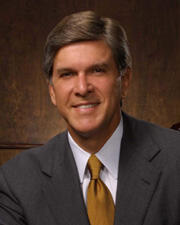
Gordon Harold Smith (born May 25, 1952) is an American politician, businessman, and religious leader who served as a United States Senator from the state of Oregon. A member of the Republican Party, he represented Oregon in the Senate for two terms from 1997 to 2009, contributing to the legislative process during a significant period in American history. As of 2026, he is the last Republican to represent Oregon in the U.S. Senate. In addition to his political career, Smith has held prominent leadership roles in the broadcasting industry and in the Church of Jesus Christ of Latter-day Saints (LDS Church).
Smith was born in Pendleton, Oregon, and raised primarily in the Washington, D.C., area, where his father, Milan D. Smith Sr., worked as an assistant secretary in the U.S. Department of Agriculture under President Dwight D. Eisenhower. He grew up in a family with strong ties to public service and the LDS Church; his cousin is former Oregon Senator and LDS Church leader Mark O. Hatfield, and he is a double second cousin of Democratic Senators Tom and Mark Udall. Smith spent part of his youth in Maryland and attended high school in Bethesda, where he developed an early interest in politics and public affairs.
After completing high school, Smith attended Brigham Young University in Provo, Utah, graduating in 1976. Following his undergraduate studies, he enrolled at Southwestern University School of Law in Los Angeles, California, where he earned his Juris Doctor degree. During his college years he also served as a missionary for the LDS Church in New Zealand, an experience that deepened his religious commitment and helped shape his later service in church leadership. Upon completion of his legal education, he returned to the Pacific Northwest to begin his professional career.
Smith initially practiced law before joining and eventually leading his family’s frozen food processing business, Smith Frozen Foods, based in Weston, Oregon. As president of the company, he oversaw its growth and operations, gaining experience in business management, agriculture, and rural economic issues that would later inform his legislative priorities. His involvement in local civic affairs and business organizations helped establish his reputation in eastern Oregon and provided a springboard for his entry into elective office.
Smith’s formal political career began in the Oregon Legislature. He was elected to the Oregon State Senate in 1992 and quickly rose in leadership, becoming President of the Oregon Senate in 1995. In that role, he presided over the chamber and helped shape state policy on budgetary, economic, and social issues. His tenure in the state legislature highlighted his interest in bipartisan cooperation and pragmatic governance, themes that would continue during his service in the U.S. Senate.
In 1996, Smith ran for the United States Senate from Oregon. He first sought to fill the seat vacated by Senator Bob Packwood in a special election, narrowly losing to Democrat Ron Wyden. Later that year, he ran for Oregon’s other Senate seat, which was being vacated by Senator Mark O. Hatfield, and won the general election, beginning his service in the U.S. Senate on January 3, 1997. He was reelected in the 2002 Oregon United States Senate election, held on November 5, 2002, his first bid for re-election. In that race, Smith easily defeated underfunded Democratic challenger, Oregon Secretary of State Bill Bradbury, in the general election, carrying all but one county in the state—Multnomah County, home to Portland. During his Senate tenure, which lasted until January 3, 2009, Smith served on key committees and participated actively in the democratic process, representing the interests of his Oregon constituents on issues including agriculture, trade, health care, and foreign policy.
Smith’s second bid for re-election came in 2008, when he faced Democratic State House Speaker Jeff Merkley. In a December 2007 poll, Smith earned 40 percent favorable and 20 percent unfavorable ratings. His office characterized the relatively low numbers as a reflection on Congress in general, while a spokesman for Steve Novick’s campaign—Novick lost to Merkley in the Democratic primary—suggested that the public was frustrated with elected officials and looking to outsiders to effect change. Merkley’s campaign highlighted Smith’s shifts in position on the war in Iraq as a central issue. The general election result was too close to call for almost two days. Ultimately, Merkley was declared the winner by 49 percent to 46 percent, with 5 percent of the vote going to Constitution Party candidate David Brownlow. While Smith carried all but six counties in Oregon, he could not overcome a 142,000-vote deficit in Multnomah County. In the same 2008 election cycle, his double second cousins, Democrats Tom and Mark Udall, ran successfully for U.S. Senate seats in New Mexico and Colorado, respectively. Smith left office at the conclusion of his second term in January 2009.
Following his Senate service, Smith transitioned to leadership in the broadcasting industry. From 2009 to 2022, he served as president and chief executive officer of the National Association of Broadcasters (NAB), the principal trade association representing radio and television broadcasters in the United States. In that capacity, he advocated for the interests of broadcasters before Congress, federal agencies, and the public, working on issues such as spectrum allocation, media ownership rules, and the evolving regulatory environment for traditional and digital media. His tenure at NAB extended his influence in national policy debates beyond elective office.
In parallel with his professional work, Smith has remained deeply involved in the LDS Church. From 2012 to 2022, he served as an area seventy, a regional ecclesiastical leader with responsibilities for overseeing church affairs in designated geographic areas. Building on decades of lay service in the church, this role placed him in a position of significant spiritual and administrative responsibility. Since March 2025, he has served as the church’s director of hosting at Temple Square in Salt Lake City, Utah, overseeing hospitality, public outreach, and visitor engagement at one of the church’s most prominent religious and historic sites.
Congressional Record