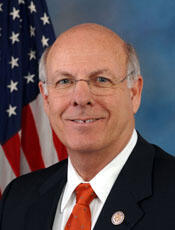
Troy Harry Teague (born June 29, 1949) is an American former oilman, small business owner, and politician who served as the U.S. representative for New Mexico’s 2nd congressional district from January 3, 2009, to January 3, 2011. A member of the Democratic Party, he represented a largely rural and historically conservative district located in the southern part of New Mexico, including Hobbs, Roswell, Carlsbad, Las Cruces, and the southern fourth of Albuquerque. His single term in Congress coincided with a period of significant national economic and political change, during which he participated in the legislative response to the late-2000s financial crisis and its aftermath.
Teague grew up in an impoverished family of sharecroppers in rural central Oklahoma and spent the first nine years of his life without running water. When he was nine years old, his family moved to Hobbs, New Mexico, in search of better opportunities. He attended Hobbs High School but left school at the age of 17 in order to work in the oil fields and help support his parents, both of whom were in poor health. These early experiences of economic hardship and manual labor in the oil industry shaped his later identity as a businessman and public official closely tied to the energy sector and working-class concerns.
Building on his early work in the oil fields, Teague became a small business owner in the energy industry. Over time, he developed his enterprise into a company that eventually employed approximately 250 people, making him a significant private-sector employer in southeastern New Mexico. His business success and long association with the petroleum industry led to his membership in the New Mexico Oil and Gas Association, reflecting his ongoing engagement with energy policy and regional economic development. Teague married Nancy Teague, and the couple has two children and five grandchildren, maintaining deep personal and professional roots in the Hobbs area.
Teague’s formal political career began at the local level in Lea County, New Mexico, a traditionally Republican stronghold. Running as a Democrat, he was elected to the Republican-controlled Lea County Board of Commissioners, where he served for eight years. During his tenure on the Board, he was elected chairman by his fellow commissioners for three and a half of those years, gaining experience in county governance, budgeting, and infrastructure issues. His ability to win and hold office as a Democrat in a heavily Republican county foreshadowed his later congressional campaign in a conservative-leaning district.
In 2008, the incumbent Republican representative for New Mexico’s 2nd congressional district, Steve Pearce, declined to seek re-election to the House in order to run for the U.S. Senate seat being vacated by Senator Pete Domenici. Pearce’s decision created an open-seat contest in a district that had been held by Republicans for nearly three decades. Teague sought the Democratic nomination and faced state legislator Bill McCamley in the primary. He won the Democratic primary with 52 percent of the vote. On the Republican side, Edward R. Tinsley, a Capitan rancher and owner of the K-Bob’s Steakhouse restaurant chain, emerged as the nominee from a five-way primary. Although New Mexico’s 2nd district had long been considered the most conservative in the state, polling indicated a competitive general election. Teague and the Democratic Party significantly outspent Tinsley and the Republican Party by more than $3 million. In the November 2008 general election, Teague won with 56 percent of the vote to Tinsley’s 44 percent, drawing strong support from the western portions of the district and from its large Latino population. His victory returned the 2nd district to Democratic control for the first time in 28 years.
During his term in the 111th Congress, Teague served on the House Committee on Transportation and Infrastructure and the House Committee on Veterans’ Affairs. Within Transportation and Infrastructure, he sat on the Subcommittee on Railroads, Pipelines, and Hazardous Materials and the Subcommittee on Water Resources and Environment, positions that aligned with his background in energy and his district’s needs in transportation and water management. On the Veterans’ Affairs Committee, he served on the Subcommittee on Economic Opportunity and the Subcommittee on Health, reflecting a focus on employment, education, and health services for veterans, a significant constituency in New Mexico.
Teague’s legislative activity reflected both his district’s economic profile and national policy debates of the time. Early in the 111th Congress, he introduced legislation to amend the Internal Revenue Code of 1986 to make the child tax credit refundable for five years and to extend tax credits for electricity produced from certain renewable resources; this bill was referred to the House Committee on Ways and Means. He co-sponsored the Southwest Border Violence Reduction Act of 2009, which sought to direct the Attorney General to expand resources for the Bureau of Alcohol, Tobacco, Firearms and Explosives to identify, investigate, and prosecute firearms trafficking across the U.S.–Mexico border; the measure was referred to the House Committee on the Judiciary and the House Committee on Foreign Affairs. On January 28, 2009, the House adopted an amendment he proposed to the American Recovery and Reinvestment Act of 2009 requiring the Recovery.gov website to include links to job information at public agencies receiving stimulus funds and at private firms contracted to perform work under the bill. Later that day, the House passed the Recovery Act by a vote of 244–188.
Teague took several notable positions on major legislation. In June 2009, he voted in favor of the American Clean Energy and Security Act, a comprehensive climate and energy bill that included a cap-and-trade system and renewable energy standards. His vote drew protests from some constituents, including Tea Party activists who disrupted a subsequent meeting to express their opposition to the bill and to his approach to constituent outreach. At the same time, a 2009 Pew Environment Group poll indicated that 69 percent of voters in New Mexico’s 2nd district would support an energy bill requiring electric utilities to generate 20 percent of their electricity from renewable sources and to reduce carbon emissions, suggesting a complex local response to energy and environmental policy. On health care, Teague was one of 39 House Democrats to vote against the Affordable Healthcare for America Act and later voted against the reconciled bill based on the Senate language on March 21, 2010, distinguishing himself from most members of his party on the central domestic policy initiative of the Obama administration.
In the 2010 midterm elections, Teague sought a second term but faced a rematch with former Republican congressman Steve Pearce, who returned to run for his old House seat after losing the 2008 Senate race. In a year marked nationally by Republican gains, particularly in swing and conservative-leaning districts, Teague was defeated on November 2, 2010. Pearce received 55 percent of the vote to Teague’s 45 percent, and Teague left Congress at the conclusion of his term on January 3, 2011. His single term nonetheless marked a rare period of Democratic representation in New Mexico’s 2nd congressional district.
After leaving Congress, Teague remained involved in political and public affairs while continuing his business activities. Reflecting his independent political judgment and the conservative leanings of his region, in 2020 he endorsed Republican Yvette Herrell in the race for his former congressional seat over the incumbent Democrat Xochitl Torres Small. Herrell went on to defeat Torres Small in the general election, returning the district to Republican control. Throughout his career, Teague’s trajectory—from an impoverished sharecropper’s son in rural Oklahoma to an oil-field worker, business owner, county commissioner, and member of Congress—has underscored his longstanding ties to New Mexico’s energy sector and his representation of a predominantly rural and working-class constituency.
Congressional Record