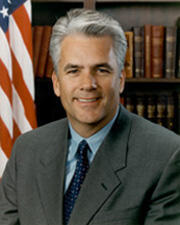
John Eric Ensign (born March 25, 1958) is an American veterinarian and former politician who represented Nevada in the United States Congress from 1995 to 2011. A member of the Republican Party, he served four terms in Congress, first as the U.S. Representative for Nevada’s 1st congressional district from 1995 to 1999—the only Republican ever to represent that district—and later as a United States Senator from Nevada from 2001 until his resignation in 2011 amid a Senate Ethics Committee investigation into his attempts to conceal an extramarital affair. Following his resignation from the Senate, Ensign returned to Nevada and resumed his career as a veterinarian.
Ensign was born in 1958 in Roseville, California, to Sharon Lee Cipriani, whose father was of Italian descent, and a father whose surname was Mueller. His parents, whom he later described as having married too young, separated when he was four years old, and he moved with his mother to Nevada. Cipriani subsequently married Michael S. Ensign, a prominent gaming industry executive who later became chairman of the board of directors of Mandalay Resort Group. Michael Ensign formally adopted John, who has referred to him as his “real father.” In political campaigns, Ensign frequently referred to his diverse ancestry, noting that he is one-eighth Filipino. As of 2008, he had never met his Philippine-born paternal grandfather, who was of Filipino-German ancestry, and he did not learn of this heritage until about 1994. In recognition of his Filipino roots, he was conferred the Order of the Knights of Rizal with the rank of Knight Grand Cross of Rizal by Filipino dignitaries in 1997.
Ensign attended the University of Nevada, Las Vegas, where he became a member of the Sigma Chi fraternity. He later transferred to Oregon State University, from which he graduated in 1981 with a Bachelor of Science degree. Pursuing a career in veterinary medicine, he enrolled at Colorado State University and received his Doctor of Veterinary Medicine (D.V.M.) degree in 1985. After completing his professional education, Ensign entered veterinary practice and became a successful businessman in Las Vegas, opening a 24-hour animal hospital and eventually owning two animal hospitals before entering electoral politics. His background as a practicing veterinarian would later inform both his public image and his legislative interests, particularly in the area of animal welfare.
Ensign’s political career began in earnest with his 1994 campaign for Nevada’s newly created 1st congressional district, based in Las Vegas. He won the Republican nomination and initially trailed four-term Democratic incumbent James Bilbray by a wide margin. The race shifted after reports emerged that a Bilbray aide stood to profit significantly from lands legislation sponsored by Bilbray, an issue that Ensign capitalized on in the campaign’s final weeks. In the general election, he narrowly defeated Bilbray by approximately 1,400 votes. Ensign was reelected in 1996 by a wider margin of about seven percentage points, even as Democratic President Bill Clinton carried the district by a large margin that year. During his tenure in the House of Representatives from January 3, 1995, to January 3, 1999, Ensign participated in the legislative process during a period of significant partisan realignment in Congress and represented the interests of his Las Vegas–area constituents as the district’s only Republican member to date.
In 1998, Ensign sought higher office by challenging Democratic incumbent Senator Harry Reid. The campaign was closely contested and ultimately decided by a razor-thin margin; Ensign lost by just 401 votes. Despite the bruising nature of the race, Ensign and Reid later developed a working relationship in the Senate and frequently cooperated on issues affecting Nevada. Ensign ran again for the Senate in 2000, this time for the seat of retiring Democratic Senator Richard H. Bryan. In that election he defeated Democratic nominee Ed Bernstein by a margin of 55 percent to 40 percent, winning a six-year term beginning January 3, 2001. He was reelected in 2006, defeating Democratic challenger Jack Carter, son of former President Jimmy Carter, by a vote of 55.36 percent to 40.99 percent after both had turned back only token opposition in their respective August 15, 2006, primaries.
During his Senate service, Ensign held several significant committee assignments. He served on the Committee on the Budget; the Committee on Commerce, Science, and Transportation, including its Subcommittees on Aviation Operations, Safety, and Security; Communications, Technology, and the Internet, where he was ranking member; and Surface Transportation and Merchant Marine Infrastructure, Safety, and Security. He also served on the Committee on Finance, with assignments to its Subcommittees on Health Care; Taxation, IRS Oversight, and Long-Term Growth; and Social Security, Pensions and Family Policy. In addition, he was a member of the Committee on Homeland Security and Governmental Affairs. Within the Senate Republican Conference, Ensign rose to a leadership role as chairman of the National Republican Senatorial Committee (NRSC), where he was responsible for recruiting candidates and directing efforts to regain a Republican majority in the 2008 elections. He selected Mike Slanker and Lindsey Slanker of the Nevada-based consulting firm November Inc. as political and finance directors for the NRSC. Despite these efforts, Republicans lost eight Senate seats in 2008, and after Senator Arlen Specter’s party switch in 2009, Democrats achieved a filibuster-proof majority.
Ensign’s legislative record reflected a consistently conservative stance on social issues. The National Right to Life Committee and NARAL Pro-Choice America both certified his anti-abortion voting record. In 2003 he authored the Child Custody Protection Act, which sought to make it a federal offense to transport a minor across state lines to circumvent state laws requiring parental involvement in a minor’s abortion decision. At the same time, he was regarded as one of the Humane Society’s strongest allies in Congress. Drawing on his professional background as a veterinarian, he joined Senators Maria Cantwell, Arlen Specter, and Dianne Feinstein as a lead sponsor of the Animal Fighting Prohibition Enforcement Act, which elevated to a felony the interstate transport of animals for the purpose of fighting. According to a press release from his office, the bill was designed to complement existing state laws, noting that fifty states already prohibited dogfighting and forty-nine prohibited cockfighting. Ensign was also a member of the Congressional Cuba Democracy Caucus, reflecting his interest in U.S. policy toward Cuba.
Ensign’s Senate career was marked by both policy initiatives and procedural controversy. In September 2007, it was revealed that he had employed the Senate’s “secret hold” rule to block consideration of a bill that would have required senators to file campaign fundraising reports electronically. He insisted that the Senate first vote on his proposed amendment to strengthen disclosure rules by requiring groups petitioning the Senate Ethics Committee to reveal the identities of donors contributing more than $5,000. Watchdog organizations criticized the move as an attempt to stymie transparency legislation. By 2009, Ensign was viewed as a rising figure in national Republican politics and scheduled a June 1 trip to Iowa, prompting speculation that he was considering a 2012 presidential campaign. Those prospects collapsed in mid-June 2009, when he publicly acknowledged an extramarital affair and subsequent efforts to conceal it. In the wake of a Senate Ethics Committee investigation, he resigned his position as chair of the Senate Republican Policy Committee on June 17, 2009. Although he announced on July 14, 2009, that he still intended to seek reelection to the Senate in 2012, his standing in public opinion polls declined, and commentators noted that he faced substantial obstacles to another term. In October 2010, he assisted Republican Senate candidate Sharron Angle by playing Harry Reid during one day of her debate preparation in Las Vegas, an action that local media speculated might strain his working relationship with Reid.
On March 7, 2011, amid the ongoing Senate Ethics Committee inquiry, Ensign announced that he would not seek reelection in 2012, stating that he wished to spare his family from what he described as an “exceptionally ugly” campaign and declaring that he needed to put his family first. National Republican leaders welcomed the decision, suggesting he would have struggled to survive a primary challenge. The Ethics Committee continued its 22‑month investigation, and before its report was released, Ensign announced on April 21, 2011, that he would resign from the Senate effective May 3, 2011. He explained that he did not want to subject his family, his constituents, or the Senate to further investigations, depositions, extended proceedings, or public hearings. The committee subsequently referred its findings to the Department of Justice for possible investigation of alleged serious violations of law. Ensign thus became the first United States Senator from Nevada to resign mid-term, other than Alan Bible, who had resigned seventeen days before the end of his term to give his successor a seniority advantage.
After leaving the Senate, Ensign returned with his family to Las Vegas, Nevada. Consistent with his original profession, he renewed his practice as a veterinarian and opened Boca Park Animal Hospital, continuing his long-standing involvement in animal care and small business.
Congressional Record