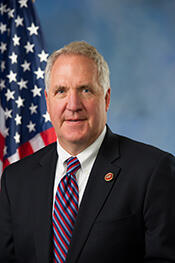
John Mondy Shimkus (born February 21, 1958) is an American politician who served as a Republican member of the United States House of Representatives from Illinois from January 3, 1997, to January 3, 2021. Over 12 consecutive terms in Congress, he represented, at different times, Illinois’s 20th, 19th, and 15th congressional districts. First elected in 1996 to succeed Democrat Dick Durbin, who successfully ran for the United States Senate that year, Shimkus became a prominent Republican voice on energy, environmental, and telecommunications policy. On August 30, 2019, he announced that he would not seek re-election in 2020 and was succeeded by fellow Republican Mary Miller.
Shimkus is a lifelong resident of Collinsville, Illinois, part of the Metro East region of the St. Louis metropolitan area. He is the son of Kathleen N. (née Mondy) and Gene L. Shimkus; his paternal grandfather was of Lithuanian descent, a heritage that would later inform his interest in Baltic issues in Congress. Raised in this working- and middle-class community, he developed early ties to the region he would later represent in the House of Representatives, maintaining his residence there throughout his political career.
Shimkus attended the United States Military Academy at West Point, where he earned his bachelor’s degree and received a commission in the United States Army. After graduation, he fulfilled a five-year active-duty commitment, serving as an infantry officer and earning the Expert Infantry Badge, the Ranger Tab, and the Parachutist Badge. He served overseas with the 54th Infantry Regiment in West Germany during the latter years of the Cold War. Following his active-duty service, he entered the United States Army Reserve, in which he continued to serve alongside his civilian career until his retirement in 2008 with the rank of lieutenant colonel. After leaving active duty, Shimkus earned a teaching certificate from Christ College Irvine (now Concordia University Irvine) and taught at Metro East Lutheran High School in Edwardsville, Illinois. He furthered his education by obtaining a Master of Business Administration degree from Southern Illinois University Edwardsville in 1987.
Shimkus’s political career began at the local level. In 1989 he was elected a Collinsville Township trustee, marking his first successful run for public office. The following year, he was elected Madison County treasurer, becoming the first Republican in a decade to win a countywide office there. He was re-elected as county treasurer in 1994, becoming the first Republican to be re-elected to that post in 60 years, a reflection of his growing political strength in a traditionally Democratic area. While still serving as Madison County treasurer, he sought higher office in 1992, winning the Republican nomination for the U.S. House seat in Illinois’s 20th congressional district. He was defeated in the general election by ten-term Democratic incumbent Dick Durbin, but the race established him as a serious contender for federal office.
In 1996, when Durbin vacated the 20th district seat to run for the U.S. Senate, Shimkus again sought the congressional seat. He won a crowded six-way Republican primary and then faced Democratic State Representative Jay C. Hoffman in a closely contested general election, prevailing by just over 1,200 votes. He took office on January 3, 1997, beginning a 24-year tenure in the House of Representatives. His early pledge not to serve more than 12 years in Congress became a point of discussion later in his career; in September 2005 he announced that he would run for re-election in 2008 despite that initial term-limit promise. Over the course of his service, he became firmly entrenched in his district, rarely facing serious electoral challenges after his initial races.
Shimkus’s congressional career spanned a period of significant political and policy change. Following the 2000 census, Illinois lost a House seat and the 20th district was disbanded, leading to a redrawing of district lines. In 2002, his constituency was merged with the 19th district, then represented by two-term Democrat David D. Phelps. Although the new district retained the 19th district number, it was geographically and demographically more similar to Shimkus’s old 20th district, with Shimkus retaining about 60 percent of his former territory. The resulting campaign was notably bitter, with both candidates accusing the other’s staffers of stalking their families. Despite a broader Democratic wave in Illinois that year, which saw Democrats capture the governorship and the state senate, Shimkus defeated Phelps with 55 percent of the vote, the only time in his congressional career that he received less than 60 percent in a re-election bid. After the 2010 census, the 19th district was also disbanded, and Shimkus ran in the newly configured 15th district, which encompassed a large part of southern and southwestern Illinois and a small portion of the Metro East. The new 15th district, on paper one of the most Republican-leaning districts in the Midwest, further solidified his electoral position; he was re-elected four more times from this district, each time with more than 70 percent of the vote.
Within the House, Shimkus became particularly active on the Committee on Energy and Commerce, one of the chamber’s most influential panels. Over the years he served on the Subcommittee on Communications and Technology, the Subcommittee on Energy and Power, the Subcommittee on Health, and the Subcommittee on Environment and Economy, where he rose to the position of ranking member. He was a key leader in the effort to reform the Toxic Substances Control Act, culminating in the 2016 Frank R. Lautenberg Chemical Safety for the 21st Century Act, which significantly updated federal regulation of industrial chemicals. He also played a central role as one of the chief Republican negotiators on the FDA Food Safety Modernization Act, legislation that expanded the Food and Drug Administration’s authority to prevent and respond to foodborne illness. Shimkus argued that when the FDA had sufficient evidence to justify a recall of tainted food, most Americans would support the government having the authority to act to protect public health. In fiscal and tax policy, he supported major Republican initiatives, including voting in favor of the Tax Cuts and Jobs Act of 2017.
Shimkus’s legislative interests extended to energy infrastructure, national security, and regulatory policy. He was a vocal proponent of the Keystone XL Pipeline project, arguing in May 2013 and on other occasions that it was preferable for the United States to rely on Canada as an energy partner rather than import oil from overseas. He supported measures to enhance the Food and Drug Administration’s recall powers and backed efforts to streamline and modernize federal regulatory frameworks. He was involved in caucus work as a member of the Republican Study Committee, the House Baltic Caucus, and the Congressional NextGen 9-1-1 Caucus, reflecting his interest in conservative policy development, Baltic security issues, and improvements to emergency communications systems. His Lithuanian heritage was often cited in connection with his work on Baltic-related matters.
Shimkus also became known for his views on climate change and environmental regulation, which drew national attention. On March 25, 2009, during introductory remarks to Christopher Monckton, 3rd Viscount Monckton of Brenchley, at a House Energy and Environment Subcommittee hearing, he described carbon dioxide as “plant food” and questioned the wisdom of policies aimed at sharply reducing CO₂ emissions, suggesting that such efforts could be counterproductive. He cited the Bible, including the story of Noah, to argue that God had promised not to destroy the Earth again by flood, using this to allay concerns about catastrophic sea-level rise. While he acknowledged that climate change is real, he questioned the effectiveness and prudence of spending taxpayer money on what he characterized as “something that you cannot stop versus the changes that have been occurring forever.” These statements placed him among the more skeptical voices in Congress regarding aggressive federal climate policy.
Throughout his tenure, Shimkus was active in Republican Party politics and campaign finance. Federal Election Commission records show that his leadership political action committee, the John S. Fund, contributed to former House Majority Leader Tom DeLay in 2005, as well as to Illinois Republican congressional candidates Peter Roskam (6th district) between 2005 and 2008 and David McSweeney (8th district) in 2006. In 2006, the fund’s treasurer, lobbyist Mark Valente, resigned. Shimkus stated that he had considered removing Valente but had been reluctant to act too quickly, concerned that it might imply impropriety in their relationship. In his own campaigns, he generally enjoyed strong support within the Republican base, though he occasionally faced intraparty challenges. When seeking his 11th term in 2016, he was challenged in the Republican primary by Illinois State Senator Kyle McCarter, who ran to his right and criticized Shimkus’s perceived accommodation with the Obama administration and national Republican leadership. With no Democratic or third-party candidates on the ballot, the primary effectively decided the seat; Shimkus prevailed with 60.4 percent of the vote to McCarter’s 39.6 percent and was subsequently re-elected unopposed in the general election.
Shimkus’s relationship with President Donald Trump and the broader Republican leadership evolved over time. He spoke favorably of Trump’s January 2017 executive order temporarily restricting immigration from several countries, stating that the pause would allow Congress and the new administration time to evaluate and improve the vetting process, while emphasizing that exceptions should be made for lawful permanent residents (green card holders) who had already undergone extensive screening. However, in October 2019 he publicly criticized Trump’s decision to withdraw U.S. troops from northern Syria, expressing concern about the implications for regional stability and America’s Kurdish allies. In protest, he resigned as a co-chair of Trump’s 2020 re-election campaign in Illinois. Earlier, on August 30, 2019, he had announced that he would not seek another term in Congress, bringing to a close a legislative career that had begun with his first election in 1996.
After retiring from the House of Representatives in January 2021, Shimkus concluded more than three decades of combined military, local, and federal public service. A lifelong resident of Collinsville, he has remained associated with the Metro East region that shaped his early life and political base. His career in Congress, spanning the late 1990s through the first two decades of the twenty-first century, placed him at the center of national debates over energy policy, environmental regulation, food safety, tax reform, and national security, while he continued to represent and advocate for the interests of his downstate Illinois constituents.
Congressional Record