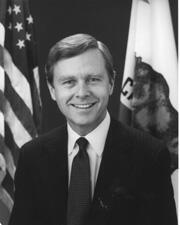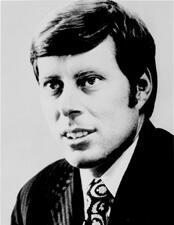
John Varick Tunney (June 26, 1934 – January 12, 2018) was an American politician who served as both a United States Representative and United States Senator from California during the 1960s and 1970s. A member of the Democratic Party, he was particularly known for his work on antitrust and environmental legislation, including the Noise Pollution Control Act of 1972 and the antitrust measure commonly known as the Tunney Act. He was also a strong supporter of civil rights and played a key role in shepherding the 1975 expansion of the Voting Rights Act. His congressional service occurred during a significant period in American history, and he participated actively in the legislative process while representing the interests of his California constituents.
Tunney was born on June 26, 1934, in New York City, the son of heavyweight boxing champion Gene Tunney and his wife, Polly Lauder Tunney, an heiress to the Carnegie fortune. Raised in a prominent Irish-American Catholic family, he grew up in an environment that combined public visibility with an emphasis on education and civic responsibility. His father’s fame and his family’s social position exposed him early to public life and national affairs, experiences that would later inform his political career.
Tunney attended Yale University, where he studied history and graduated in 1956. Following his undergraduate education, he served in the United States Air Force from 1957 to 1960, where he was a judge advocate, gaining early legal and governmental experience. After his military service, he enrolled at the University of Virginia School of Law. At Virginia, he shared a room with Edward M. “Ted” Kennedy, a fellow Irish-American Catholic, and the two became close friends. This relationship would endure throughout their political careers and place Tunney within a circle of rising national Democratic leaders. He received his law degree and was admitted to the bar, beginning the practice of law in California.
In 1964, Tunney was elected as a Democrat to the United States House of Representatives from California’s 38th congressional district, which then encompassed Riverside and Imperial counties. He took office on January 3, 1965, and served four terms in the House, remaining there until his resignation on January 2, 1971, when he left to take his seat in the Senate. During his House service, he voted in favor of landmark civil rights legislation, including the Voting Rights Act of 1965 and the Civil Rights Act of 1968. His campaigns drew national attention and support; members of the Kennedy family, including Patricia Kennedy Lawford, campaigned on his behalf, as did Jack Dempsey, his father’s former boxing rival. In July 1969, while still a congressman, Tunney was called to Hyannisport, Massachusetts, by Senator Kennedy to assist in dealing with the aftermath of the Chappaquiddick incident and the death of Mary Jo Kopechne, reflecting both their personal friendship and Tunney’s role as a trusted political adviser. In recognition of his “service to the state,” he was made an honorary member of the Phi Sigma Kappa fraternity by its California State University, Northridge chapter in 1970.
Tunney won statewide office in the 1970 United States Senate election in California, defeating incumbent Republican Senator George Murphy. He entered the Senate in January 1971 and served until January 1977. As a senator, he focused on antitrust enforcement and environmental protection, emerging as a leading advocate for regulatory measures designed to curb corporate abuses and protect public health and natural resources. He was instrumental in the passage of the Noise Pollution Control Act of 1972, which sought to regulate and reduce harmful noise levels, and he sponsored the antitrust legislation that came to be known as the Tunney Act, strengthening judicial oversight of antitrust consent decrees. Tunney also strongly supported civil rights and was a key figure in advancing the 1975 amendments to the Voting Rights Act, which expanded protections for minority voters and extended key provisions of the original 1965 law. His Senate tenure thus combined a focus on consumer and environmental issues with a sustained commitment to civil rights.
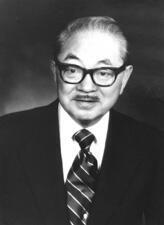
In 1976, Tunney sought reelection to the Senate but was narrowly defeated by Republican S. I. Hayakawa in a closely watched and hard-fought campaign. His Senate service, from 1971 to 1977, capped more than a decade in Congress, spanning four terms in the House and one term in the Senate. After leaving office in January 1977, he returned to the practice of law and became increasingly active in environmental causes, continuing the advocacy that had marked his legislative career. He remained engaged in public policy and civic affairs, drawing on his experience in Congress and his longstanding relationships within the Democratic Party.
In his later years, Tunney divided his time between professional work, public service, and family life. He continued to be associated with environmental activism and legal practice, and he maintained close ties with former colleagues and friends from his years in Washington. John Varick Tunney died on January 12, 2018, in Santa Monica, California. His career in the House of Representatives and the Senate, his authorship of significant antitrust and environmental legislation, and his role in advancing civil rights and voting protections left a lasting imprint on California and national public policy.
Congressional Record