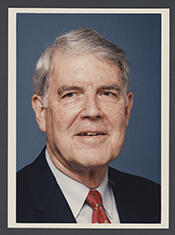
Joseph Richard Skeen (June 30, 1927 – December 7, 2003) was an American politician who served as a Republican Representative from New Mexico in the United States Congress from 1981 to 2003. A conservative Republican, he represented a largely rural, southern New Mexico district and served for eleven terms in the United States House of Representatives, contributing to the legislative process during a significant period in American history and participating in the democratic process on behalf of his constituents.
Skeen was born on June 30, 1927, in Roswell, Chaves County, New Mexico. During his teenage years, his family moved to Seattle, Washington, where he completed his secondary education. In the final year of World War II, he entered the United States Navy, serving his country in uniform as the global conflict drew to a close. After his military service, Skeen pursued higher education and graduated from Texas A&M University in College Station, Texas, preparing for a career that would combine agriculture, business, and public service.
Before his election to Congress, Skeen was active in New Mexico public life and Republican politics, building a reputation as a conservative advocate for the interests of his state. He developed close ties to the agricultural and ranching communities of southern New Mexico and became known for his attention to local economic needs and infrastructure. This background positioned him as a credible and well-known figure when an unexpected congressional vacancy arose in 1980.
Skeen’s entry into the U.S. House of Representatives came under highly unusual circumstances. Incumbent five-term Democratic Congressman Harold Runnels was renominated in the Democratic primary and was set to be unopposed in the general election after the Republican Party failed to nominate any candidate. Runnels suddenly died of cancer on August 5, 1980, at the age of fifty-six. The state attorney general issued an advisory opinion that the Democrats could replace Runnels on the ballot, as he had been nominated in the primary, but Republicans could not, as no Republican candidate had filed in the preceding primary election. In response, Republicans coalesced behind a write-in effort by Skeen, while the Democrats selected Governor Bruce King’s nephew, David King, over Runnels’ widow, Dorothy Runnels. Dorothy Runnels then decided to run her own write-in campaign after failing to be selected by the Democratic Party. In the general election, Skeen was elected with 61,564 votes (38 percent) to King’s 55,085 (34 percent) and Runnels’ 45,343 (28 percent). He was aided by the splitting of the Democratic vote between King and Runnels, as well as by Ronald Reagan carrying the district in the presidential election. Skeen thus became only the third person in United States history to be elected to Congress as a write-in candidate.
During his eleven terms in the House of Representatives, from January 3, 1981, to January 3, 2003, Skeen maintained a largely conservative voting record while also focusing on bringing federal projects and resources to his district. He served during a period that spanned the Reagan, George H. W. Bush, Clinton, and early George W. Bush administrations, and he was involved in legislative debates on defense, agriculture, public lands, and federal spending that were central to New Mexico’s interests. Although he enjoyed relatively easy reelection campaigns from 1982 through 1990, including two completely unopposed bids in 1988 and 1990, he faced more competitive Democratic challenges throughout much of the 1990s as the political landscape of his district shifted. On October 10, 2002, in one of the most consequential foreign policy votes of his later career, Skeen voted in favor of authorizing the invasion of Iraq.
Skeen’s long tenure in Congress was marked by both personal and political challenges. In 1997 he publicly announced that he had been diagnosed with Parkinson’s disease, a progressive neurological disorder. Despite this diagnosis, he continued to serve and to seek reelection, remaining active in legislative work and constituent services. In 2002, after more than two decades in the House, he announced his retirement from Congress and left office at the end of his eleventh term in January 2003, concluding a notable career in national public service.
Joseph Skeen died on December 7, 2003. At the time of his death, he was widely regarded by New Mexicans in both parties for his long service to the state and his effectiveness in securing federal support for local needs. His legacy in New Mexico is reflected in several facilities named in his honor, including the Joe Skeen Campground at Bluewater Lake State Park and the Skeen Library at New Mexico Tech, which commemorate his contributions to the state’s public lands, education, and infrastructure.
Congressional Record