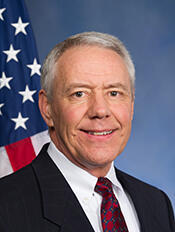
Kenneth Robert Buck (born February 16, 1959) is an American lawyer and Republican politician who represented Colorado’s 4th congressional district in the United States House of Representatives from January 3, 2015, until his resignation on March 22, 2024. Over five terms in Congress, he was known as a staunch fiscal conservative, an early and active member of the House Freedom Caucus, and one of the foremost proponents of antitrust enforcement within the Republican Party. In addition to his congressional service, Buck chaired the Colorado Republican Party from 2019 to 2021 and previously served as district attorney for Weld County, Colorado. He also sought higher office as the Republican nominee for the U.S. Senate in 2010, losing a closely watched race to Democratic Senator Michael Bennet.
Buck was born in New York City on February 16, 1959, and grew up in a family that later settled in Colorado. He attended Princeton University, where he played football and graduated in 1981 with a Bachelor of Arts degree in politics. After college, he worked on Capitol Hill as a staff member for the U.S. House of Representatives Iran-Contra investigation, gaining early exposure to federal oversight and investigative work. He then enrolled at the University of Wyoming College of Law, earning his Juris Doctor in 1985, and was admitted to the bar, beginning a legal career that would span federal prosecution, private practice, and local law enforcement leadership.
Following law school, Buck joined the U.S. Department of Justice, serving as a prosecutor in the U.S. Attorney’s Office. He later became chief of the criminal division in the U.S. Attorney’s Office for the District of Colorado, where he handled a range of federal criminal matters and supervised other prosecutors. After leaving federal service, he worked in the private sector, including a position with Hensel Phelps Construction Company as a business executive and attorney. In 2004, Buck was elected district attorney for Colorado’s 19th Judicial District, based in Weld County, where he oversaw felony prosecutions and local criminal justice policy. His tenure as district attorney drew both support and controversy, most notably in connection with his decision not to prosecute an admitted rapist in a 2005 sexual assault case. In that matter, a tape recorded by Greeley police captured the suspect acknowledging the conduct—“You do realize that … it’s rape.” “Yeah, I do.”—and the victim emphasizing her lack of consent, intoxication, and fear. Despite this, Buck declined to bring charges. In a subsequent conversation the victim recorded, Buck appeared to question her motives and suggested a jury would not convict, telling her that it appeared she had invited the man, a former lover, over to have sex and implying she might be seeking retaliation. He later told the Greeley Tribune in 2006 that “a jury could very well conclude that this is a case of buyer’s remorse,” a comment the victim said made her feel blamed for the assault. Reporting by the Colorado Independent in 2010 highlighted Buck’s focus on the woman’s sexual history and alcohol consumption, as well as his reference to the suspect’s claim that she had previously become pregnant and had an abortion—an assertion she denied, saying she had miscarried—as a possible motive for her complaint. The handling of the case became a significant issue in Buck’s later statewide campaigns and was cited by critics as emblematic of broader concerns about his judgment and approach to victims’ rights.
Angered by what he later described as the nation’s “lurch to the left,” Buck announced his candidacy for the U.S. Senate on April 28, 2009, entering his first statewide race while still serving as Weld County district attorney. In the 2010 Republican primary, he positioned himself as a Tea Party-aligned, anti-establishment conservative, emphasizing opposition to the Patient Protection and Affordable Care Act, the Troubled Asset Relief Program, and the use of federal “czars,” while repeatedly stressing mounting federal debt. Initially viewed as a “dead-in-the-water” candidate with weak fundraising and little establishment support against former Lieutenant Governor Jane Norton, Buck ran what he called a “bottom-up” campaign, pledging to visit each of Colorado’s 64 counties and casting himself as a small-money underdog. His fortunes improved after Americans for Job Security spent nearly $600,000 on television advertising on his behalf and after he won a key victory at the state party caucuses in March 2010, leading to increased endorsements and national attention. The primary became highly competitive and contentious, with Buck drawing criticism for remarks about Tea Party activists—asking an aide to “tell those dumbasses at the Tea Party to stop asking questions about birth certificates while I’m on the camera”—and for a comment suggesting voters should choose him over Norton because, unlike her, “I do not wear high heels,” which he later characterized as a joking response to her claim that he was not “man enough” to attack her. Norton and her allies also highlighted Buck’s past mandatory ethics classes and alleged rule violations from his time as a federal prosecutor, prompting calls from Colorado Democrats for his resignation as district attorney. Despite the controversies, Buck defeated Norton in the August 10, 2010, Republican primary, 52 percent to 48 percent, emerging as a prominent figure among anti-establishment conservatives in Colorado and nationally. He went on to lose the general election to incumbent Senator Michael Bennet in a closely contested race.
In 2013, Buck faced a personal health challenge when he was diagnosed with lymphoma. On August 19, 2013, he emailed supporters to announce that his lymphoma was in remission following treatment and that he would run for the U.S. Senate again, this time against Democratic Senator Mark Udall in 2014. He had already filed his candidacy on August 7, 2013. However, in March 2014, after Representative Cory Gardner entered the Senate race, Buck withdrew and instead chose to run for Gardner’s open seat in Colorado’s 4th congressional district. In the 2014 Republican primary for the House seat, Buck defeated three other candidates with 44 percent of the vote and then won the general election with 65 percent of the vote over Democratic nominee Vic Meyers. He took office in the 114th Congress on January 3, 2015, beginning a decade-long tenure in the U.S. House of Representatives.
During his time in Congress, Buck consistently aligned with the conservative wing of the Republican Party. He joined the House Freedom Caucus, where he advocated for reduced federal spending, limited government, and strict constitutionalism. At the same time, he emerged as one of the leading Republican voices in favor of robust antitrust enforcement, particularly in relation to large technology companies and market concentration, reflecting a strand of conservative skepticism toward corporate power. Buck was reelected multiple times by wide margins. He ran for reelection unopposed in the Republican primary and defeated Democratic nominee Bob Seay in the general election with 63.5 percent of the vote. In a subsequent cycle, he again ran unopposed in the Republican primary and defeated Democratic nominee Karen McCormick with 60.6 percent of the vote. In another reelection bid, he faced no Republican primary opposition and defeated Democratic nominee Ike McCorkle with 60.1 percent of the vote. In a later race, Buck won the Republican primary against Robert Lewis and then defeated McCorkle a second time in the general election with 60.9 percent of the vote. These results underscored the solidly Republican character of the 4th district and Buck’s enduring support among its voters.
In the House, Buck served on the Committee on Foreign Affairs and the Committee on the Judiciary, assignments that reflected both his legal background and his interest in national security and constitutional issues. On the Foreign Affairs Committee, he sat on the Subcommittee on the Indo-Pacific and the Subcommittee on the Western Hemisphere, participating in oversight of U.S. foreign policy in key strategic regions. On the Judiciary Committee, he served on the Subcommittee on Immigration Integrity, Security, and Enforcement, where he engaged in debates over border security and immigration law, and on the Subcommittee on the Administrative State, Regulatory Reform, and Antitrust, a platform from which he advanced his views on limiting regulatory overreach and strengthening antitrust enforcement. In addition to his committee work, Buck chaired the Colorado Republican Party from 2019 to 2021, balancing state party leadership with his congressional responsibilities and playing a role in candidate recruitment and party strategy during a politically polarized period.
Buck’s final term in Congress unfolded amid intense national debates over elections, the rule of law, and the direction of the Republican Party. In November 2023, he announced that he would not seek a sixth House term, explaining that he was troubled by what he described as his party’s “insidious narratives” that, in his view, “breed widespread cynicism and erode Americans’ confidence in the rule of law.” On March 12, 2024, he further announced that he would resign his seat at the end of the following week, setting his departure for March 22, 2024, and bringing his service in the House to a close before the end of the 118th Congress. Colorado Governor Jared Polis scheduled a special election to fill the vacancy for June 25, 2024. Buck’s career, spanning federal prosecution, local law enforcement, party leadership, and nearly a decade in Congress, reflected both the rise of insurgent conservative politics in the early 21st century and the internal tensions within the Republican Party over law, governance, and the role of government in the economy.
Congressional Record