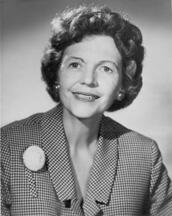
Maurine Neuberger-Solomon, best known as Maurine Neuberger (née Brown; January 9, 1907 – February 22, 2000), was an American politician who served as a United States senator from Oregon from November 1960 to January 1967. A member of the Democratic Party, she was the sixth woman elected to the United States Senate and the tenth woman to serve in the body. She and her first husband, Senator Richard L. Neuberger, are widely regarded as the Senate’s first husband-and-wife legislative team, and she remains, to date, the only woman elected to the U.S. Senate from Oregon.
Neuberger was born in Cloverdale, Tillamook County, Oregon, and grew up in the state’s public school system. She attended the Oregon College of Education at Monmouth (now Western Oregon University) from 1922 to 1924, preparing for a teaching career, and then enrolled at the University of Oregon. She graduated from the University of Oregon in 1929 with a Bachelor of Arts degree. During her undergraduate years she was active in campus life, becoming a member of the Delta Zeta sorority and being selected in her junior year to Mortar Board, the national college senior honor society, in recognition of her scholarship and leadership.
After college, Brown embarked on a career in education. She taught in Oregon public schools between 1932 and 1944, a period during which she gained firsthand experience with the concerns of working families and communities that would later inform her legislative priorities. Seeking further professional development, she undertook graduate study at the University of California at Los Angeles from 1936 to 1937. In 1937, while teaching at a high school in Portland, she met Richard L. Neuberger, a journalist and future legislator. Their relationship developed over the ensuing years, and the couple married in 1945 after Richard completed his service in the United States Army during World War II.
Maurine Neuberger entered elective politics in her own right in 1950, when she was elected to the Oregon House of Representatives. She served in the state House from 1950 to 1955, representing a Portland district and quickly establishing a reputation for independence and diligence. In the 1952 election, she was reelected to the Oregon House at the same time her husband was reelected to the Oregon State Senate; notably, she received more votes than he did in their respective races. During this period she also broadened her engagement with international and civic affairs, serving on the board of directors of the American Association for the United Nations. Richard Neuberger was elected to the United States Senate in 1954, and the couple became a prominent Democratic team in Oregon politics.
Her service in the United States Senate began under somber circumstances. In 1960, Richard Neuberger died of cancer while in office. Oregon Governor Mark Hatfield appointed Hall S. Lusk to fill the vacancy temporarily, and Maurine Neuberger became the Democratic candidate in the special election to complete her late husband’s term. On November 8, 1960, she won the special election to fill the vacancy, and she served from November 9, 1960, to January 3, 1961, completing the remainder of Richard Neuberger’s term. Simultaneously, she was elected in the regular general election for the full six-year term beginning January 3, 1961. Thus, she served two consecutive terms in the Senate—first the unexpired portion of her husband’s term and then her own full term—remaining in office until January 3, 1967. She chose not to be a candidate for reelection in 1966.
During her Senate career, which coincided with a significant period in American history marked by the civil rights movement, the early stages of the Vietnam War, and major expansions in federal social policy, Neuberger focused her legislative efforts on consumer protection, environmental conservation, and public health. She became particularly known for her advocacy of stronger labeling requirements and consumer information. She sponsored one of the first bills in Congress to require warning labels on cigarette packaging, reflecting growing public concern about the health effects of smoking. In 1964, Time magazine described her as “a longtime crusader for labeling laws,” underscoring her national reputation in this field. She also supported measures related to natural resource conservation and was attentive to the interests of her Oregon constituents, including agricultural and rural communities.
Neuberger’s influence extended beyond the Senate chamber through her work on national commissions and task forces. In 1961, President John F. Kennedy appointed her to the Presidential Commission on the Status of Women, where she contributed to early federal efforts to examine and address gender inequality in American life. From 1965 to 1968, she and Muriel Fox co-chaired then–Vice President Hubert Humphrey’s task force on Women’s Goals, helping to shape policy discussions on women’s rights, employment, and civic participation during a formative era for the modern women’s movement. Her service in Congress thus combined direct legislative work with broader advocacy for women’s status and consumer rights.
On July 11, 1964, while serving in the Senate, Maurine Neuberger married Dr. Philip Solomon, a psychiatrist who was Clinical Professor of Psychiatry at Harvard Medical School and Physician-in-Chief of the Psychiatry Service at Boston City Hospital. Following this marriage, she was sometimes addressed as Maurine Neuberger-Solomon; a 1965 article noted that Governor Mark Hatfield addressed correspondence to her under this married name, with the apparent intention of making her 1964 remarriage an issue in a potential 1966 Senate campaign. The marriage ended in divorce in 1967, the year she left the Senate.
After concluding her congressional service in January 1967, Neuberger remained active in public life as an educator and lecturer. She was employed as a lecturer on consumer affairs and the status of women, drawing on her Senate experience and national policy work. She taught American government at Boston University, at the Radcliffe Institute for Advanced Study at Harvard University, and later at Reed College in Portland, Oregon. Through these academic and public-speaking roles, she continued to influence debates on consumer protection, women’s rights, and civic engagement, and she remained a visible figure in Oregon’s political and intellectual life.
Maurine Neuberger spent her later years in Portland, Oregon, maintaining her ties to the state she had represented in both the state legislature and the United States Senate. She died in Portland on February 22, 2000, at the age of 93, from a bone marrow disorder. She is interred in Beth Israel Cemetery in Portland. Her career, spanning teaching, state legislative service, and a notable tenure in the U.S. Senate, left a lasting imprint on consumer legislation, women’s public roles, and the political history of Oregon.
Congressional Record