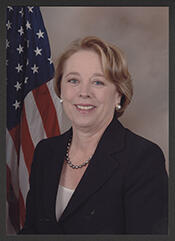
Nicola Dickson “Niki” Tsongas (née Sauvage; born April 26, 1946) is an American politician and attorney who served as a U.S. Representative from Massachusetts from 2007 to 2019. A member of the Democratic Party, she held the seat formerly represented by her husband, the late Paul Tsongas, serving the district numbered as Massachusetts’s 5th congressional district from 2007 to 2013 and as Massachusetts’s 3rd congressional district from 2013 to 2019, following redistricting after the 2010 census. Over six terms in office, she contributed to the legislative process during a significant period in American history, participating in the democratic process and representing the interests of her constituents. In August 2017 she announced that she would not seek another term in the November 2018 election.
Tsongas was born Nicola Dickson Sauvage on April 26, 1946, in Chico, California. Her mother, Marian Susan (née Wyman), was an artist and copywriter, and her father, Colonel Russell Elmer Sauvage, was an engineer in the United States Army Air Forces who survived the attack on Pearl Harbor. Because of her father’s military career, she spent part of her childhood abroad and graduated in 1964 from Narimasu American High School in Japan while her father was stationed at Fuchu Air Force Base. She attended Michigan State University for one year before transferring to Smith College in Northampton, Massachusetts, where she earned a Bachelor of Arts degree in religion in 1968. After college she moved to New York City and worked as a social worker for the Department of Welfare, an early experience that informed her later interest in public service and social policy. She subsequently enrolled at Boston University School of Law, where she earned a Juris Doctor and later helped establish Lowell’s first all-female law practice. She is an Episcopalian.
Tsongas’s political awareness and national-level engagement began in the 1960s. In the summer of 1967 she interned in Arlington, Virginia, for anti–Vietnam War presidential candidate Senator Eugene McCarthy. At a party during that period she met Paul Tsongas, then an aide to Republican Congressman Brad Morse. The two married in 1969 and settled in Massachusetts, where they raised three daughters: Ashley, Katina, and Molly. Paul Tsongas was elected to the U.S. House of Representatives from Massachusetts’s 5th congressional district, serving from 1975 to 1979, and then to the U.S. Senate, serving from 1979 to 1985. After being diagnosed with non-Hodgkin lymphoma, he declined to seek a second Senate term and resigned the day before his term expired so he could focus on treatment. The family returned from Washington, D.C., to Massachusetts during this period. After a period in which his disease appeared to be in remission, Paul Tsongas ran for the Democratic nomination for president in 1992, ultimately finishing third behind former California Governor Jerry Brown and the eventual nominee, Governor Bill Clinton. His cancer later returned, and he died of pneumonia and liver failure on January 18, 1997.
Alongside her family responsibilities, Niki Tsongas built a career in law, education, and civic leadership in Lowell and the Merrimack Valley. In addition to her legal practice, she served as dean of external affairs at Middlesex Community College, where she worked to strengthen ties between the college and the surrounding communities. She served on the board of Fallon Health and on the Lowell Civic Stadium and Arena Commission, which oversees several facilities including the Tsongas Arena, a multipurpose venue named in honor of her husband. In 2001 Representative Marty Meehan appointed her to head a foundation established to provide education funding for children of the victims of the September 11, 2001, terrorist attacks, further extending her involvement in public and philanthropic initiatives.
Tsongas entered electoral politics in her own right after Representative Marty Meehan resigned from Congress in 2007 to become chancellor of the University of Massachusetts Lowell. She ran in the special election to fill the vacancy in Massachusetts’s 5th congressional district. In the Democratic primary she defeated four other candidates, winning with 36 percent of the vote. Her campaign received endorsements from major regional newspapers, including The Boston Globe, the Boston Herald, and the Lowell Sun. During the general election campaign, former President Bill Clinton—who had defeated her husband in the 1992 Democratic presidential primaries—campaigned on her behalf, remarking at an event in Lowell that “Congress will be a better place because she is there.” On October 17, 2007, Tsongas won the special election against Republican Jim Ogonowski with 51 percent of the vote. Upon taking office, she became the only female representative from Massachusetts and the first woman from the state to serve in the U.S. House since the 1983 retirement of Margaret Heckler, who had become Secretary of Health and Human Services under President Ronald Reagan.
Tsongas’s early legislative activity in Congress reflected the central issues of her 2007 campaign. A major point of contention in the special election was whether the candidates would vote to override President George W. Bush’s veto of an expansion of the State Children’s Health Insurance Program (SCHIP). Tsongas pledged that she would vote to override the veto, while it was reported that Ogonowski would not. Just hours after being sworn into office on October 18, 2007, she cast her vote to override the veto; the effort failed to achieve the necessary two-thirds majority. She also campaigned on ending the Iraq War and, as a new member, introduced her first bill to implement a timetable for the withdrawal of U.S. troops from Iraq. In 2010 she joined a congressional delegation of women, including House Speaker Nancy Pelosi, on a visit to Afghanistan to oversee aspects of the war effort; upon her return she emphasized the importance of women’s involvement in rebuilding Afghan governance and civil society.
Over the course of her six terms, Tsongas developed a record as a liberal Democrat with particular focus on health care, social policy, and civil rights, while occasionally working across the aisle on specific economic issues. She advocated universal health care and supported a public health insurance option. In 2010 she voted for the Patient Protection and Affordable Care Act and the Health Care and Education Reconciliation Act, central components of President Barack Obama’s domestic agenda. In 2012 she joined a Republican-led effort to repeal a 2.3 percent sales tax on medical-device manufacturers, a measure that passed the House by a vote of 270–146 and drew the support of 36 other Democrats, reflecting the importance of the medical-device industry to Massachusetts. Tsongas was consistently pro-choice and received a 100 percent approval rating from Planned Parenthood in 2008. She was also a strong supporter of LGBT rights, cosponsoring the Respect for Marriage Act to repeal the Defense of Marriage Act and voting for the Don’t Ask, Don’t Tell Repeal Act of 2010, which allowed gay and lesbian Americans to serve openly in the United States Armed Forces.
Tsongas’s electoral career in the House was marked by both uncontested races and competitive campaigns. She ran unopposed in 2008. In 2010 she faced Republican challenger Jon Golnik, a small businessman and former Wall Street currency trader who had served as a vice president at AIG. During the campaign she criticized Golnik’s tenure at AIG, a firm at the center of the 2008 financial crisis, while he countered that her attacks were hypocritical because she owned stock in AIG and other large corporations. Tsongas was reelected with 52 percent of the vote. Following redistricting after the 2010 census, her constituency was renumbered as Massachusetts’s 3rd congressional district. In 2012 she again faced Golnik in a rematch and won reelection. During this period she also took notable public positions within her party, including being the only member of the Massachusetts House delegation to call for the resignation of Representative Anthony Weiner after his first sexting scandal, stating that it would be appropriate for him to step down. In the 2012 Massachusetts Senate race she became the first major Democratic politician to endorse Elizabeth Warren, describing her as “a fighter for middle-class families.”
In addition to her work on domestic policy, Tsongas engaged in environmental and cultural issues and maintained an interest in international affairs. In January 2013 she introduced the Nashua River Wild and Scenic River Study Act (H.R. 412, 113th Congress), which sought to amend the Wild and Scenic Rivers Act to authorize a study of certain segments of the Nashua River in Massachusetts for potential inclusion in the National Wild and Scenic Rivers System. In testimony supporting the bill, she recounted the river’s history of industrial pollution and subsequent cleanup, arguing that the study would enable federal, state, and local stakeholders to work together to ensure that the river remained a valuable resource for canoeing, fishing, and outdoor recreation. She was a member of the Congressional Arts Caucus, reflecting her support for arts and culture, and of the U.S.-Japan Caucus, an affiliation that resonated with her own upbringing on a U.S. military base in Japan.
Tsongas was occasionally mentioned as a potential candidate for higher office. After President Obama nominated Senator John Kerry to serve as Secretary of State, there was widespread speculation that she might run in the special election for the U.S. Senate seat that her husband had once held. She briefly considered the possibility but ultimately concluded that she could best serve the people of Massachusetts by remaining in the House of Representatives. She endorsed her colleague, Representative Ed Markey, who went on to win the seat. In August 2017 she announced that she would not seek reelection in 2018, bringing to a close twelve years of congressional service when her term ended in January 2019.
In recognition of her contributions to the city of Lowell and the broader region she represented, an 87-foot pedestrian and bicycle bridge in Lowell, opened in 2022, was named the Niki Tsongas Bridge. Her career has been marked by a combination of local engagement in education and civic development, national legislative work on health care, civil rights, and environmental protection, and a continuation of the public service legacy associated with the Tsongas name in Massachusetts politics.
Congressional Record