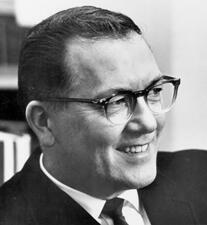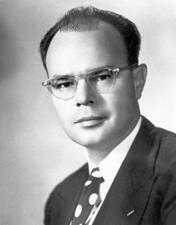
Patrick Vincent McNamara (October 4, 1894 – April 30, 1966) was an American politician who represented Michigan in the United States Senate from January 3, 1955, until his death in 1966. A member of the Democratic Party, he served two terms in the Senate during a significant period in American history, contributing to the legislative process and representing the interests of his Michigan constituents. Over the course of his Senate career, he emerged as an influential voice on aging, public works, labor, and social welfare policy.
McNamara was born in North Weymouth, Massachusetts, to Patrick Vincent and Mary Jane (née Thynne) McNamara, Irish immigrants who settled in New England. The oldest of eight children, he was educated in the public schools of his native town and attended the local high school for two and a half years. He then transferred to the Fore River Apprentice School in nearby Quincy, where he learned the trade of pipe fitting. In 1916, he began working as a pipe fitter and foreman at the Fore River Shipyard, gaining practical experience in industrial work that would later inform his labor leadership and political career. Between 1919 and 1920, he also played semi-professional football, reflecting his early engagement in community and team activities.
Seeking broader opportunities in the industrial Midwest, McNamara moved to Detroit, Michigan, where he worked as foreman of a construction crew for the Grinnell Company. He married Kathleen Kennedy, with whom he had two children, Mary Jane (born 1922) and Patrick (born 1925). His first wife, Kathleen, died of pneumonia on March 8, 1930, in Detroit. On September 3, 1932, he married Mary Mattee in Detroit. Professionally, he advanced through a series of supervisory positions in the construction and industrial sectors: he served as job superintendent for the R.L. Spitzley Company from 1922 to 1926 and as general superintendent of the H. Kelly Company from 1926 to 1930. From 1930 to 1932, he took extension courses at the University of Michigan in Ann Arbor, furthering his education while continuing to work. He was maintenance foreman at a Chrysler plant from 1931 to 1934 before joining the Donald Miller Company, and in 1937 he became president of Pipe Fitters Local 636, a post he held until 1955. He also served as vice president of the Detroit chapter of the American Federation of Labor from 1939 to 1945, establishing himself as a prominent labor leader in Detroit’s industrial economy.
During World War II, McNamara played a role in the federal wartime regulatory apparatus as rent director of the Office of Price Administration in Detroit from 1942 to 1945, administering rent controls and contributing to home-front stabilization efforts. After the war, he joined the Stanley-Carter Company, where he held a series of executive responsibilities, including superintendent of construction, customer contact man, head of labor relations, and vice president. His combined experience in organized labor, industrial management, and wartime administration positioned him as a figure capable of bridging labor, business, and government interests.
McNamara’s formal political career began in municipal government. In 1946, he made his first bid for public office and won a special election to fill an unexpired term on the Detroit City Council. In that race he carried twenty-one of the city’s twenty-three wards, an early indication of his broad appeal among urban voters. He served on the council until 1947. He later continued his involvement in local public affairs as a member of the Detroit Board of Education from 1949 to 1955, participating in the governance of the city’s public school system during a period of postwar growth and demographic change.
In 1954, McNamara sought higher office by challenging former Senator Blair Moody for the Democratic nomination for a United States Senate seat from Michigan. Most political analysts initially gave him little chance of defeating Moody, a well-known figure, but the race was dramatically altered when Moody died two weeks before the primary election. McNamara secured the Democratic nomination and went on to face two-term Republican incumbent Homer S. Ferguson in the general election. During the campaign, he criticized President Dwight D. Eisenhower’s economic, labor, and farm policies, aligning himself with more activist Democratic positions on social and economic issues. In November 1954, he narrowly defeated Ferguson by a margin of 51 percent to 49 percent, and he took his seat in the Senate on January 3, 1955. He was reelected in 1960, defeating Republican Alvin Morell Bentley, and continued to serve until his death in 1966.
During his tenure in Congress, McNamara became particularly noted for his work on issues affecting older Americans, public infrastructure, and labor. In the 87th Congress, he became the first chairman of the Senate Special Committee on Aging, where he convened influential hearings on the health and economic security of the elderly. The 1959 committee hearings he called on the subject of the health of the elderly helped initiate a broader public debate that contributed to the eventual creation of the Medicare program. He also chaired the Senate Committee on Public Works in the 88th and 89th Congresses, from 1963 to 1966, overseeing major federal public works initiatives, including aspects of federal highway acts and infrastructure development. In addition to these leadership roles, he served on the Labor and Public Welfare Committee, the Select Committee on Improper Activities in the Labor or Management Field, and the Select Subcommittee on Poverty, engaging with legislation on civil rights, atomic energy, education, taxation, labor relations, and anti-poverty efforts. He was associated with Americans for Democratic Action, reflecting his alignment with the liberal wing of the Democratic Party during the mid-twentieth century.
Patrick Vincent McNamara died of a stroke at Bethesda Naval Hospital in Bethesda, Maryland, on April 30, 1966, at the age of 71, while still serving in the United States Senate. He was interred in Mount Olivet Cemetery in Detroit, underscoring his long association with the city he had represented and served in various capacities. His legacy in Michigan and in national policy is reflected in the naming of the Patrick V. McNamara Federal Building in Detroit in his honor. McNamara donated his archival papers to the Walter P. Reuther Library, where they are open to the public for research. The bulk of these materials relate to his time in the Senate and his work on the Public Works Committee (which he chaired from 1963 to 1966), the Labor and Public Welfare Committee, the Select Committee on Improper Activities in the Labor or Management Field, the Select Subcommittee on Poverty, and the Special Committee on Aging. The papers document subjects such as problems of the aged, civil rights, atomic energy, education, taxes, public works, federal highway acts, and labor, and include correspondence with major political figures of the period as well as many labor leaders. A filmed interview, “Longines Chronoscope with Patrick V. McNamara,” preserved at the Internet Archive, provides additional contemporary insight into his views and public persona.
Congressional Record