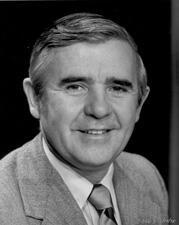
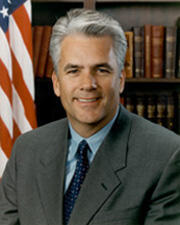
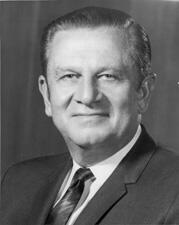
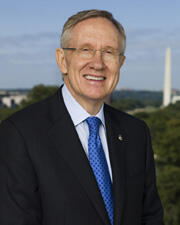
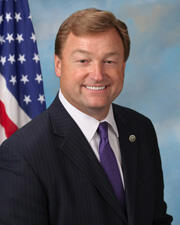
Richard Hudson Bryan (born July 16, 1937) is an American retired politician and attorney who served as the 25th Governor of Nevada from 1983 to 1989 and as a United States Senator representing Nevada from 1989 until 2001. A member of the Democratic Party, he previously served as Nevada’s attorney general and as a member of the Nevada State Senate, and later completed two terms in the United States Senate. Over the course of his career, Bryan became one of Nevada’s most prominent public officials, holding major offices in all three branches of state government before representing the state in Congress.
Bryan was born in Washington, D.C., on July 16, 1937. He moved to Nevada at a young age and was educated in the state’s public schools before enrolling at the University of Nevada, Reno. He graduated from the University of Nevada at Reno in 1959, where he was active in campus life as a member of the Alpha Tau Omega fraternity and served as president of the Associated Students of the University of Nevada (ASUN). Following his undergraduate studies, Bryan attended the University of California, Hastings College of the Law in San Francisco, earning his Juris Doctor degree. He was admitted to the Nevada Bar in 1963, marking the beginning of a legal career that would soon lead him into public service.
After admission to the bar, Bryan established himself in legal practice and public defense work in southern Nevada. He became Clark County’s first public defender, helping to build and lead the county’s indigent defense system at a time of expanding constitutional protections for criminal defendants. His work in this role, combined with his growing involvement in Democratic Party politics, raised his profile in Nevada’s legal and political communities and set the stage for his entry into elective office.
Bryan was elected to the Nevada Senate in 1972 and served as a state senator from 1972 to 1978. During his tenure in the Nevada Legislature, he participated in shaping state policy in areas such as education, criminal justice, and economic development, gaining a reputation as a capable legislator and an effective advocate for his constituents. In 1979, he was elected Nevada Attorney General and served in that position from 1979 to 1983. As attorney general, Bryan was the state’s chief legal officer, representing Nevada in court, advising state agencies, and overseeing law enforcement and consumer protection matters, further solidifying his standing as a leading figure in state government.
In 1982, Bryan ran for governor of Nevada, challenging incumbent Republican Governor Robert List, who was seeking reelection. Bryan defeated List in the general election and took office as the 25th Governor of Nevada in January 1983. As governor, he focused on issues including economic diversification, education, and state fiscal management during a period of growth and change in Nevada’s tourism- and gaming-based economy. He was easily reelected in 1986, defeating Republican State Treasurer Patricia Cafferata. Bryan became known in Carson City for his frequent invitations to state legislators of both parties to join him for meals at the governor’s mansion, a practice that fostered goodwill and bipartisan cooperation between the executive and legislative branches.
By 1987, several prominent Democratic politicians, including U.S. Senators Harry Reid of Nevada and Alan Cranston of California, encouraged Bryan to seek a seat in the United States Senate. He declared his candidacy and, in the 1988 U.S. Senate election, ran against incumbent Republican Senator Chic Hecht. Bryan defeated Hecht in the general election and was sworn in as a United States Senator from Nevada at the convening of the 101st Congress on January 3, 1989. He served in the Senate from 1989 to 2001, completing two full terms in office and contributing to the legislative process during a significant period in American political history.
During his Senate tenure, Bryan served on several key committees, including the Committee on Finance, the Committee on Banking, Housing, and Urban Affairs, the Select Committee on Intelligence, and the Committee on Commerce, Science, and Transportation. His committee assignments placed him at the center of debates over federal taxation and budget policy, financial regulation, national security and intelligence oversight, and transportation and technology issues. Among his most notable policy positions was his opposition to federal funding for the Search for Extraterrestrial Intelligence (SETI). In 1993–1994 he criticized the program as an unproductive expenditure of public funds, remarking that “as of today millions have been spent and we have yet to bag a single little green fellow. Not a single Martian has said take me to your leader, and not a single flying saucer has applied for FAA approval.” He introduced an amendment to the 1994 federal budget that secured the cancellation of NASA’s High Resolution Microwave Survey, effectively terminating NASA’s SETI efforts less than a year after they had begun.
Bryan was also a leading opponent of using Nevada’s Yucca Mountain as a long-term national repository for high-level nuclear waste. Throughout his Senate service, he worked to delay and block efforts to begin storage at the site, arguing that it posed environmental and safety risks to Nevada and that the state should not be compelled to bear a disproportionate share of the nation’s nuclear waste burden. Although the Yucca Mountain nuclear waste repository was advanced as a federal project during his time in office, his opposition helped delay any actual storage from occurring. His stance on Yucca Mountain continued after his retirement from the Senate, and plans for storage at the site were ultimately discontinued during the administration of President Barack Obama. Bryan ran for reelection to the Senate in 1994 and was easily returned to office, defeating Republican challenger Hal Furman. In 2000, he chose not to seek a third term and left the Senate at the conclusion of his second term in January 2001.
After retiring from elective office, Bryan returned to private life and legal practice in Nevada, remaining active in civic and public affairs. He has been associated with law and consulting firms and has served on boards and advisory bodies, drawing on his long experience in state and federal government. His senatorial papers are preserved in the Special Collections of the University Libraries at the University of Nevada, Reno, providing a documentary record of his legislative work and his role in Nevada and national politics. Bryan has also appeared in various public forums and media, including C‑SPAN, reflecting on his years as governor and senator and on the policy issues that defined his career.
Congressional Record