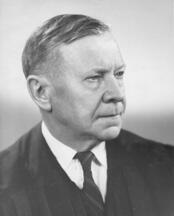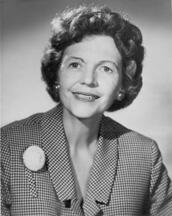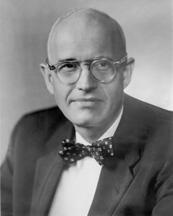
Richard Lewis Neuberger (December 26, 1912 – March 9, 1960) was an American journalist, author, and Democratic politician who represented Oregon in the United States Senate from 1955 until his death in 1960. A native of Oregon, he gained national prominence as a correspondent and author before entering elective office, and he became one of the leading liberal voices in his state during a period of Republican dominance. His widow, Maurine Brown Neuberger, later won election to complete and then hold his Senate seat.
Neuberger was born on December 26, 1912, in the rural part of Multnomah County, Oregon, the son of Ruth (Lewis) and Isaac Neuberger, who owned a restaurant. All of his grandparents were German Jewish immigrants, and he grew up in nearby Portland, Oregon, within that community. He attended public schools in Portland and entered the University of Oregon in the early 1930s. As a 19‑year‑old freshman he first encountered Wayne Morse, then dean of the University of Oregon law school, who would later become his Senate colleague and, eventually, a political antagonist. At the university Neuberger served as editor of the student newspaper, the Oregon Daily Emerald, and became involved in campus affairs and public debate.
Neuberger graduated from the University of Oregon in 1935. While still a college senior he began writing for The New York Times, and by 1939 he had become the newspaper’s Northwest correspondent. During these years he also embarked on a parallel career as an author. His early books included An Army of the Aged (co‑written with Kelley Loe, 1936), Integrity: the Life of George W. Norris (1937), and Our Promised Land (1938), works that reflected his interest in social policy, progressive politics, and the American West. He continued to write throughout his life, later publishing The Lewis and Clark Expedition (1951), Royal Canadian Mounted Police (1953), and Adventures in Politics: We Go to the Legislature (1954), which drew on his own legislative experience.
In 1940 Neuberger was elected to the Oregon House of Representatives, marking his formal entry into politics as a Democrat. His legislative career was interrupted by World War II, during which he served in the U.S. Army as an officer from 1942 to 1945. After his military service he returned to civilian life in Oregon, resumed his work for The New York Times, and continued to write books and articles. He sought a seat in the Oregon State Senate, losing in 1946 but winning election in 1948. In the state legislature he emerged, along with fellow state senator and future governor Robert Holmes, as one of the leading liberals at a time when Republicans dominated Oregon politics. During the 1949 legislative session, Democrats succeeded in forcing a vote on one of the nation’s earliest fair employment practices laws, though the measure was ultimately watered down by the Republican majority.
Neuberger’s personal life was closely intertwined with his political career. In 1945 he married Maurine Brown, a schoolteacher who would later become an influential political figure in her own right. The couple had no children but worked together in political and civic causes. As his reputation grew in Oregon and nationally, Neuberger became known for his advocacy of conservation, civil rights, and social welfare policies, themes that would carry over into his later service in the United States Senate.
In 1954 Neuberger was elected as a Democrat to one of Oregon’s seats in the United States Senate, becoming the first Democrat to win a Senate seat from Oregon since 1914. He took office on January 3, 1955, and served one term in the Senate until his death in 1960. As a member of the Senate during a significant period in American history, he participated in the legislative process and represented the interests of his Oregon constituents while aligning himself with the liberal wing of the Democratic Party. A vigorous and outspoken liberal, he was a member of the Wilderness Society and took a particular interest in conservation and public lands. One lasting mark of his Senate service was his sponsorship of legislation to create the Oregon Dunes National Recreation Area on the Pacific Coast of Oregon. He first introduced a bill to establish the area in 1959; although the proposal was defeated repeatedly for twelve years, it was ultimately enacted and signed into law in 1972. He also sponsored the initial version of the Alaska Mental Health Enabling Act of 1956, an important measure in the development of mental health services in the then‑territory of Alaska. On July 7, 1955, he introduced into the Congressional Record a call for the total abolition of all motor racing in the United States, reflecting his concern over public safety.
Neuberger’s years in the Senate were also marked by a complex and increasingly contentious relationship with Wayne Morse, Oregon’s senior senator. The two had known each other since 1931, when Morse, as law school dean, had defended the young Neuberger against charges of academic cheating at the University of Oregon. Although Morse successfully used his rhetorical skills to protect Neuberger in the honor proceedings, the episode left lasting scars. After the charges were dropped, Neuberger rejected Morse’s advice to leave the university and instead enrolled in Morse’s criminal law class, in which Morse initially gave him a “D” and, after Neuberger complained, changed the grade to an “F.” According to biographer Mason Drukman, even after both men entered the Senate neither could fully move beyond the events of 1931. Morse viewed Neuberger as flawed in character, while Neuberger could not forgive Morse for his role in the episode. Although Morse helped Neuberger during his narrow 1954 Senate campaign—Neuberger won by only 2,462 votes out of more than half a million cast—he continued to offer advice that Neuberger did not always welcome. “I don’t think you should scold me so much,” Neuberger wrote to Morse during that campaign. By 1957 their relationship had deteriorated to the point that they exchanged angry letters, delivered almost daily by messenger between their nearby offices, rather than speaking face‑to‑face. Leaks of these letters and comments to colleagues made the feud public, and contemporaries often struggled to discern its precise cause. Drukman characterized the conflict as a classic struggle between a dominating father figure and a rebellious son, a feud that ended only with Neuberger’s death.
Neuberger’s Senate career was cut short by serious illness. In 1958 he was diagnosed with testicular cancer, a condition that became terminal by 1960 but was not disclosed to the public. Early in 1960 he remained at his home in northwest Portland, reportedly battling the flu, while still publicly seeking re‑election. In private, however, he confided to his campaign chair, attorney Jack Beatty, “Remember, there’s always another Neuberger,” a reference to his wife Maurine and a hint that he understood the gravity of his condition. Beatty, noting Neuberger’s reluctance to appear in public and his weak voice on the telephone, suspected that the senator was gravely ill, a suspicion confirmed shortly before Neuberger died of a cerebral hemorrhage at Good Samaritan Hospital in Portland on March 9, 1960, at the age of 47. A delegation of senators led by Democratic Majority Leader Lyndon B. Johnson attended his funeral, and he was buried at Beth Israel Cemetery in Portland. His widow, Maurine Brown Neuberger, subsequently won election to his U.S. Senate seat for a full six‑year term, extending the Neuberger presence in the Senate.
In the years after his death, Neuberger’s legacy continued to be recognized in Oregon. Portland State University named one of its principal academic buildings Neuberger Hall in 1972 in his honor. Following renovations completed in 2018, the name Neuberger Hall was transferred to the university’s Richard and Maurine Neuberger Center office building, while the renovated classroom building was renamed Fariborz Maseeh Hall. Neuberger’s papers are preserved at the University of Oregon, documenting his work as a journalist, author, and legislator. He is remembered as part of the broader history of Jewish members of the United States Congress and is listed among the members of Congress who died in office between 1950 and 1999.
Congressional Record