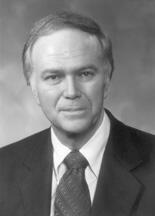
Robert William Packwood (born September 11, 1932) is an American retired lawyer and Republican politician from Oregon who served as a member of the Oregon House of Representatives representing the 6th district from 1963 to 1969 and as a United States Senator from Oregon from January 3, 1969, to October 1, 1995. Over the course of five Senate terms, he contributed to the legislative process during a significant period in American history, participating in the democratic process and representing the interests of his constituents. He resigned from the U.S. Senate in 1995 under threat of expulsion after allegations of sexual harassment, sexual abuse, and assault of women emerged. Since the death of Fred R. Harris in November 2024, Packwood has been the earliest-serving living U.S. senator, the last living former U.S. senator who assumed office in the 1960s, and the last living former U.S. senator who served during the presidency of Lyndon B. Johnson.
Packwood was born in Portland, Oregon, to Frederick William and Gladys Dorothy (Taft) Packwood. He is the great-grandson of William Packwood, the youngest member of the Oregon Constitutional Convention of 1857, and he inherited his great-grandfather’s political interests from an early age. He graduated from Grant High School in Portland in 1950 and went on to attend Willamette University in Salem, Oregon, where he graduated in 1954. During his undergraduate years, he was active in Young Republican organizations and worked on political campaigns, including the first campaign of future Oregon governor and U.S. senator Mark Hatfield for the Oregon House of Representatives.
After college, Packwood received the prestigious Root-Tilden-Kern Scholarship to attend New York University School of Law. At NYU, he earned national awards in moot court competition and was elected student body president, demonstrating early skill in advocacy and leadership. He graduated from NYU School of Law in 1957, was admitted to the bar, and returned to Oregon to practice law in Portland. His legal career provided the professional foundation for his subsequent entry into partisan politics and legislative work at both the state and national levels.
Packwood’s formal political career began in local party organization. In 1960, he was elected chairman of the Multnomah County Republican Central Committee, becoming the youngest party chairman of a major metropolitan area in the United States. In 1962, he ran for the Oregon House of Representatives and, after a highly organized and energetic campaign that The Oregonian described as “one of the most effective working organizations in many an election moon in Oregon,” he was elected and became, at that time, the youngest member of the Oregon Legislature. He represented the 6th district in the Oregon House from 1963 to 1968. Known for his effective campaign techniques, he organized a political action committee that recruited Republican candidates statewide and trained them in “Packwood-style” campaigning. The success of these candidates contributed to a Republican takeover of the Oregon House in 1964, making Oregon the only state in which Republicans scored a significant legislative victory that year. In 1965, he founded the Dorchester Conference in Seaside, Oregon, an annual political conclave on the Oregon coast that deliberately bypassed formal party leadership to bring Republican officeholders and citizens together to debate issues and pass resolutions. Initially a forum for liberal Republican politics, the Dorchester Conference evolved into a major networking event for Oregon Republicans.
In 1968, Packwood secured the Republican nomination for the U.S. Senate and ran against Democratic incumbent Wayne Morse, a former Republican who had switched parties and was nationally known for his liberal positions. Initially considered a long shot, Packwood gained momentum after an eleventh-hour debate before the City Club of Portland, widely viewed as a victory for the challenger. Following a statewide recount in which more than 100,000 ballots were challenged by both parties, Packwood was declared the winner by approximately 3,500 votes. When he took office on January 3, 1969, he replaced Senator Ted Kennedy of Massachusetts as the youngest member of the U.S. Senate. He was subsequently re-elected to the Senate in 1974, 1980, 1986, and 1992, serving continuously until his resignation in 1995.
During his Senate career, Packwood developed a reputation as a moderate Republican with a distinctive mix of positions. He supported restrictions on gun ownership and consistently backed liberal civil rights legislation. He voted for the legislation establishing Martin Luther King Jr. Day as a federal holiday and supported the Civil Rights Restoration Act of 1987, including voting to override President Ronald Reagan’s veto of that measure. He frequently differed with President Richard Nixon on key issues, voting against Nixon’s Supreme Court nominees Clement Haynsworth and G. Harrold Carswell, and opposing administration proposals such as the Rockwell B-1 bomber, Trident-capable submarines, and the Supersonic Transport (SST) program. He became the first Republican senator to support the impeachment process against Nixon, telling the president in a White House meeting on November 15, 1973, that the public no longer believed him or trusted the integrity of his administration.
Packwood was an early and prominent supporter of abortion rights. Two years before the Supreme Court’s 1973 decision in Roe v. Wade, he introduced the Senate’s first bill to legalize abortion nationwide, though he was unable to attract a co-sponsor at that time. His advocacy for abortion rights earned him strong support from feminist organizations and awards from groups such as the Planned Parenthood Federation of America in January 1983 and the National Women’s Political Caucus in October 1985. His stance on reproductive rights also shaped his approach to judicial nominations: he crossed party lines in 1987 to vote against the nomination of Robert Bork to the Supreme Court and was one of only two Republican senators to vote against the confirmation of Clarence Thomas in 1991, both votes grounded in concerns about the nominees’ opposition to abortion rights. He was also known as an ardent supporter of Israel and opposed the proposed sale of F-15 fighter jets to Saudi Arabia during the Reagan administration.
Beyond social issues, Packwood played a significant role in environmental and economic legislation. He was instrumental in the enactment of the Hells Canyon National Recreation Area Act, sponsoring legislation that created a 652,488-acre national recreation area along the Oregon–Idaho border to protect Hells Canyon, the deepest river gorge in North America. Environmental advocates praised his support for solar energy, container-deposit legislation, and the development of bike paths. At the same time, he was a strong proponent of deregulation, particularly in the transportation sector. In the late 1970s, he emerged as a leading advocate of trucking deregulation and was regarded as a persuasive spokesman for regulatory reform. His legislative skills extended to tax policy: as chairman of the Senate Finance Committee in the mid-1980s, he played a central role in shaping the Tax Reform Act of 1986. Initially indifferent to President Reagan’s 1984 call for tax reform, Packwood ultimately helped craft a tax code overhaul that raised business taxes by roughly $120 billion over five years while reducing personal income taxes by a comparable amount. Known for his sharp debating skills—rated “A+” by USA Today in July 1986—he was also an effective floor tactician, credited with helping to defeat President Bill Clinton’s 1993 health care reform proposal. His determination was illustrated in 1988, when he was carried feet-first into the Senate chamber by Capitol Police to secure a quorum for a vote on campaign finance reform.
Packwood’s political career began to unravel in November 1992, when The Washington Post published a story detailing allegations of sexual abuse and assault by ten women, primarily former staffers and lobbyists. The article, delayed until after the 1992 election while the newspaper sought additional corroboration and Packwood denied the claims, appeared shortly after he had won re-election over Democratic U.S. Representative Les AuCoin by a margin of 52.1 percent to 46.5 percent, his narrowest victory since 1968. Over time, a total of 19 women came forward with allegations. The Senate Ethics Committee investigation soon focused on Packwood’s extensive personal diaries. He initially turned over about 5,000 pages to the Senate Select Committee on Ethics but resisted when the committee demanded an additional 3,200 pages. It was later discovered that he had edited the diaries, removing entries that allegedly described sexual encounters and referenced the accusations against him. During this period, he suggested he might reveal misconduct by other members of Congress, further inflaming tensions.
The Ethics Committee’s inquiry culminated in a lengthy report. According to contemporary accounts, including The New York Times, the committee’s indictment ran to ten volumes and 10,145 pages, much of it drawn from Packwood’s own writings. The committee concluded that he had engaged in a “habitual pattern of aggressive, blatantly sexual advances, mostly directed at members of his own staff or others whose livelihoods were connected in some way to his power and authority as a Senator,” and that he had “deliberately altered and destroyed relevant portions of his diary” containing what he himself had described as “very incriminating information.” Despite calls from the public and from several female senators, including Barbara Boxer of California, for open hearings, the Senate opted against them. On September 7, 1995, the Ethics Committee, chaired by Republican Senator Mitch McConnell of Kentucky, unanimously recommended Packwood’s expulsion from the Senate. The following morning, as the committee’s findings were released and bipartisan pressure mounted, Packwood announced his resignation, stating that he was aware of the dishonor that had befallen him and that it was his duty to resign. Democratic U.S. Representative Ron Wyden subsequently won the seat in a special election. After the scandal became public, Packwood entered the Hazelden Betty Ford Foundation clinic in Minnesota for treatment of alcoholism, attributing his misconduct in part to his drinking. In later reflections on the episode during the 1998 impeachment proceedings against President Bill Clinton, McConnell noted that Republicans had understood that forcing Packwood out would likely cost them the seat, but concluded that they had to choose between retaining the seat and retaining their honor.
Following his departure from the Senate, Packwood transitioned to work as a lobbyist and policy consultant. He founded Sunrise Research Corporation, a lobbying firm through which he used his expertise in tax and trade policy, as well as his experience as a former chairman of the Senate Finance Committee, to represent a range of corporate clients, including Freightliner Trucks, Marriott International, and the now-defunct Northwest Airlines. Among other efforts, he played a key role in the 2001 campaign to repeal the federal estate tax. He remained engaged in tax policy debates into the next decade; in 2015, he returned to the Senate as a witness before the Senate Finance Committee, appearing alongside former Senator Bill Bradley of New Jersey to discuss the Tax Reform Act of 1986 and its implications for contemporary tax reform efforts.
Congressional Record