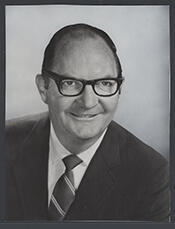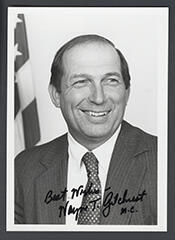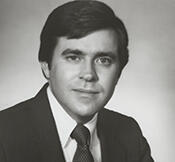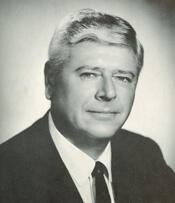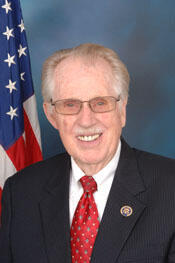
Roscoe Gardner Bartlett Jr. (born June 3, 1926) is an American politician, scientist, and educator who represented Maryland’s 6th congressional district in the United States House of Representatives from January 3, 1993, to January 3, 2013. A member of the Republican Party, he served ten consecutive terms and was associated with several conservative groups in Congress, including the Republican Study Committee, the Republican Main Street Partnership, the Liberty Caucus, and the Tea Party Caucus. At the end of his tenure in Congress, Bartlett was the second-oldest serving member of the House of Representatives, behind fellow Republican Ralph Hall of Texas.
Bartlett was born in Moreland, Jefferson County, Kentucky, on June 3, 1926, to Martha Minnick and Roscoe Gardner Bartlett. He spent his childhood in rural conditions and completed his early education in a one-room schoolhouse. Raised in the Seventh-day Adventist tradition, he enrolled at Columbia Union College (now Washington Adventist University) in Takoma Park, Maryland, an institution affiliated with the Seventh-day Adventist Church. He graduated in 1947 with a Bachelor of Science degree in theology and biology, with a minor in chemistry. Initially intending to become a Seventh-day Adventist minister, he was considered too young for the ministry after receiving his bachelor’s degree at age 21, a circumstance that helped redirect him toward an academic and scientific career.
Encouraged to pursue further study, Bartlett entered the University of Maryland, College Park, where he focused on anatomy, physiology, and zoology. He earned a master’s degree in physiology in 1948 and was subsequently hired to the university’s faculty, teaching anatomy, physiology, and zoology while working toward his doctorate. In 1952 he received a Ph.D. in physiology from the University of Maryland. His early academic career included lecturing at Loma Linda University School of Medicine in Loma Linda, California, another institution affiliated with the Seventh-day Adventist Church, from 1952 to 1954. He then served as an assistant professor at Howard University College of Medicine in Washington, D.C., from 1954 to 1956. Beyond his formal academic posts, Bartlett later conducted research related to the U.S. space program, including work with primates, experience that would inform his later legislative interest in bioethics and animal research.
Bartlett’s first forays into electoral politics were unsuccessful but established his long-term engagement with public life. In 1980 he ran in the Republican primary for the United States Senate from Maryland, finishing fourth with 7 percent of the vote in a contest won by incumbent Senator Charles Mathias, who received 55 percent. In 1982 he sought election to the U.S. House of Representatives from Maryland’s 6th congressional district, winning the Republican primary with 52 percent of the vote but losing the general election to incumbent Democratic Representative Beverly Byron, who defeated him by a margin of 74 percent to 26 percent. A decade later, after Maryland’s 6th district was significantly redrawn, Bartlett again ran for the seat in 1992. He won the Republican primary with 42 percent of the vote. That fall, Byron was unexpectedly defeated in the Democratic primary by State Delegate Thomas Hattery, regarded as somewhat more liberal, prompting many conservative Democrats in the district to shift their support to Bartlett. In the November general election he defeated Hattery by a margin of 54 percent to 46 percent, securing his place in the 103rd Congress.
During his twenty years in the House of Representatives, Bartlett repeatedly won re-election between 1994 and 2006 with at least 56 percent of the vote, becoming a durable Republican presence in a largely rural and suburban district. As the lone Republican in Maryland’s congressional delegation for much of his tenure, he cultivated a reputation as a staunch fiscal and social conservative with particular interests in national defense, energy policy, and constitutional interpretation. He served on the Committee on Armed Services, where he chaired the Subcommittee on Tactical Air and Land Forces and also sat on the Subcommittee on Seapower and Projection Forces. On the Committee on Science, Space and Technology, he served on the Subcommittee on Research and Science Education and the Subcommittee on Energy and the Environment. He was also a member of the Committee on Small Business, including its Subcommittee on Agriculture, Energy and Trade. In addition to his committee assignments, he joined or helped found several caucuses, including the Peak Oil Caucus (which he co-founded with Representative Tom Udall of New Mexico), the Liberty Caucus, the Republican Study Committee, the Republican Main Street Partnership, the Tea Party Caucus, the Congressional Caucus on Turkey and Turkish Americans, and the Congressional Immigration Reform Caucus. Press reports indicated that his political action committee bore the acronymic name Because All Responsible Taxpayers Like Every Truth Told PAC, or BARTLETT PAC.
Bartlett’s legislative record reflected both his conservative ideology and his scientific background. In 1993 he voted against the North American Free Trade Agreement (NAFTA) Implementation Act, aligning with members who expressed concern about its economic and sovereignty implications. In November 1997 he was one of eighteen House Republicans to co-sponsor a resolution introduced by Representative Bob Barr to launch an impeachment inquiry against President Bill Clinton; the resolution did not specify charges and predated the Clinton–Lewinsky scandal. On October 8, 1998, he voted in favor of legislation to open a formal impeachment inquiry, and on December 19, 1998, he voted in favor of all four proposed articles of impeachment, two of which were adopted by the House. Drawing on his background in physiology and his interest in national security, Bartlett was reported to have been instrumental in arranging House hearings on the dangers of an electromagnetic pulse (EMP) attack on the United States. He also became a prominent congressional advocate of the geologic theory of peak oil, warning that “the end of cheap oil and natural gas is coming and coming fast” as global demand outstrips production. In 2005 he established the Congressional Peak Oil Caucus, arguing that federal revenues from offshore oil and gas production should be invested in the development of renewable energy sources.
Bartlett’s scientific training also shaped his views on bioethics and animal research. In August 2011 he co-authored an op-ed in The New York Times calling for an end to invasive research on primates, drawing on his own earlier work with primates in the U.S. space program. He joined Senator Maria Cantwell in introducing the Great Ape Protection and Cost Savings Act, legislation estimated to save the federal government $300 million over ten years if enacted, by curtailing invasive research on great apes and promoting their retirement to sanctuaries. He took a strong interest in fiscal issues involving federal agencies, opposing, for example, a 2012 Senate bill to provide the United States Postal Service with an additional $33 billion in funding, which he characterized as an “irresponsible bailout,” while stating his support for maintaining next-day delivery standards in rural areas, including keeping open the Cumberland, Maryland, mail processing facility.
Throughout his congressional career, Bartlett was known for outspoken and sometimes controversial statements. In 2012, when Missouri Congressman Todd Akin made widely criticized comments about female biology and rape in the context of abortion, Bartlett, drawing on his background as a human physiologist, immediately repudiated Akin’s remarks, stating, “There is no room in politics for these types of statements… As a human physiologist I know there is no scientific backing to Todd’s claims.” He described his own position on abortion as “pro-life, with exceptions for the life of the mother, rape and incest,” and added that he was “so avidly pro-life” that he opposed corporal punishment, while acknowledging that a very small proportion of abortions result from rape. It was later noted that in 2001 he had supported a constitutional amendment that did not include rape and incest exceptions, a discrepancy that political opponents highlighted. In September 2012, at a town hall meeting, he asserted that federal student loans were unconstitutional and warned that disregarding the Constitution was a “very slippery slope” toward an event like the Holocaust; he subsequently apologized for the Holocaust comparison. His positions and remarks drew frequent criticism from the Maryland Democratic Party, which also sought to link him politically to Akin’s comments.
Bartlett’s later campaigns were marked by changing district demographics and increased scrutiny of his finances and campaign operations. According to the Frederick News-Post, he had under-reported property sales by over $1 million since 2004 on his official financial disclosure forms and had made $299,000 in unreported loans in connection with the sale of his daughter’s home, over which he exercised power of attorney. Bartlett characterized the under-reporting as an oversight and described himself as a “bit player” in the real estate transactions. In 2012 the Federal Election Commission fined his campaign $5,000 for repeatedly failing to submit accurate campaign finance disclosure reports; Bartlett responded by hiring an accountant to address outstanding disclosure issues. Despite these controversies, he remained electorally successful for many years, winning reelection in 2010 at the age of 84, when he was the only Republican in Maryland’s congressional delegation. That cycle, Democrat and Iraq War veteran Andrew Duck formally announced a campaign for Bartlett’s seat on June 1, 2009, but Bartlett ultimately retained the seat.
Following the 2010 census, Maryland’s 6th congressional district was extensively redrawn in a redistricting plan released in October 2011 that was widely described as gerrymandering. The new lines shifted the district southward, adding heavily Democratic areas closer to Washington, D.C. A largely Republican section of Frederick County and an even more strongly Republican section of Carroll County were moved into the heavily Democratic 8th district, while heavily Republican portions of Harford and Baltimore counties and another section of Carroll County were reassigned to the already Republican-leaning 1st district. In exchange, a heavily Democratic section of Montgomery County was added to the 6th district. The political impact was substantial: while Senator John McCain had carried the old 6th district with 57 percent of the vote in the 2008 presidential election, the reconfigured district would have been carried by Barack Obama with 56 percent. In the 2012 election, Bartlett faced Democrat John Delaney and Libertarian Nickolaus Mueller. Amid the more Democratic electorate and ongoing controversies, Bartlett was heavily defeated by Delaney in the general election, receiving 38 percent of the vote to Delaney’s 59 percent, ending his two-decade tenure in Congress.
After leaving office in January 2013, Bartlett withdrew from public life to a considerable degree. Known for his longstanding interest in self-reliance, energy scarcity, and rural living, he has been reported to reside in a remote area and to maintain his advocacy for issues such as peak oil and constitutional government outside the formal structures of elected office. As of the mid-2010s and beyond, he has remained a figure of interest for his unusual combination of scientific expertise, religious background, and strongly held views on energy, national security, and limited government, as well as for his distinctive role as a long-serving Republican representative from an increasingly Democratic state.
Congressional Record