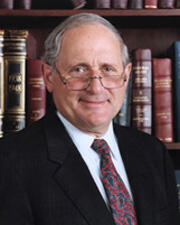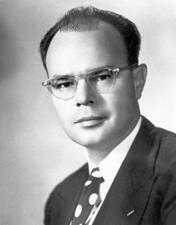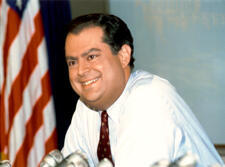
Edward Spencer Abraham (born June 12, 1952) is an American attorney, author, and politician who served as the 10th United States Secretary of Energy from 2001 to 2005 under President George W. Bush. A member of the Republican Party, he previously served as a United States Senator from Michigan from January 3, 1995, to January 3, 2001, completing one term in office. Abraham is one of the founders of the Federalist Society and a co-founder of the Harvard Journal of Law & Public Policy. As of 2025, he is the last Republican to have served as a U.S. Senator from Michigan.
Abraham was born in East Lansing, Michigan, the son of Juliette Elizabeth (Sear) Abraham, who was active in state politics as a member of the Michigan Republican State Central Committee, and Eddie Joseph Abraham. Of Lebanese descent, he was raised in East Lansing and graduated from East Lansing High School. He went on to attend Michigan State University, where he studied in the Honors College and graduated in 1974. He then enrolled at Harvard Law School, earning a Juris Doctor degree. While at Harvard in 1978, he helped found the Harvard Journal of Law & Public Policy, which later became one of the official journals associated with the Federalist Society, itself founded in 1982 and of which Abraham is recognized as one of the early founders and organizers.
Before entering elective office, Abraham pursued an academic and legal career. He served as a law professor at Thomas M. Cooley Law School in Michigan, teaching and writing in the field of law while becoming increasingly active in Republican politics. In 1983 he was elected chairman of the Michigan Republican Party, a position he held until 1990. During his tenure, he played a central role in party organization and candidate recruitment at the state level. Abraham then moved into national politics, serving as deputy chief of staff to Vice President Dan Quayle from 1990 to 1991. From 1991 to 1993 he was co-chairman of the National Republican Congressional Committee, helping to coordinate House Republican campaign strategy. In 1993 he sought the chairmanship of the Republican National Committee, finishing second to Haley Barbour.
Abraham was elected to represent Michigan in the United States Senate in the 1994 election and took office on January 3, 1995. He served until January 3, 2001, after being defeated for reelection in 2000 by Democrat Debbie Stabenow. During his Senate tenure, he was the only Lebanese American serving in the chamber and represented Michigan during a period of significant political and economic change in the United States. He served on the Committee on the Budget; the Committee on Commerce, Science, and Transportation; the Committee on the Judiciary; and the Committee on Small Business. Within these assignments, he chaired two subcommittees: the Subcommittee on Manufacturing and Competitiveness and the Subcommittee on Immigration, where he played a prominent role in shaping policy on trade, technology, and immigration.
Abraham’s legislative record in the Senate reflected a focus on technology, commerce, and immigration policy. He authored the H1B Visa in Global and National Commerce Act, which expanded high-skilled immigration and helped establish a federal framework for online contracts and electronic signatures. He sponsored the Government Paperwork Elimination Act, promoting electronic government transactions, and the Anti-Cybersquatting Consumer Protection Act, designed to protect Internet domain names for businesses and individuals against trademark and related infringements. In 1996, when President Bill Clinton endorsed Representative Barbara Jordan’s proposed cuts to legal immigration, Abraham played a leading role in blocking those reductions, a stance that later earned him the “Defender of the Melting Pot” award from the National Council of La Raza in 2000. In 1999 he co-sponsored S. 896, a bill to abolish the U.S. Department of Energy, which would have transferred much of the responsibility for the Strategic Petroleum Reserve to the Department of Defense. During his 2000 reelection campaign, he faced intense opposition from various advocacy groups; according to The New York Times, state Republicans attributed his defeat in part to “scathing advertisements” by special interest groups, including anti-immigration commercials run by the Federation for American Immigration Reform that linked his immigration positions to terrorism. These ads, which asked why he was “trying to make it easier for terrorists like Osama bin Laden to export their war of terror,” were widely denounced in the media as “vengeful.” Another factor cited in his defeat was his vote to convict President Clinton in the 1999 impeachment trial.
In 2001, President George W. Bush appointed Abraham as Secretary of Energy, despite Abraham’s earlier support for legislation to abolish the department. He was confirmed by the Senate and served as the 10th United States Secretary of Energy from 2001 until 2005. In that role, he oversaw national energy policy during a period marked by concerns over energy security, electricity markets, and the early stages of renewed interest in nuclear power and alternative energy. On November 15, 2004, Abraham announced that he would resign, effective upon the swearing-in of his successor, Samuel W. Bodman, on February 1, 2005. In 2004, in recognition of his public service and heritage, Lebanese Ambassador Farid Abboud presented Abraham with the National Order of the Cedar, one of Lebanon’s highest honors.
After leaving federal office, Abraham remained active in public policy, business, and political affairs. From 2005 to 2007 he served as a Distinguished Visiting Fellow at the Hoover Institution at Stanford University, focusing on energy and national security issues. He founded The Abraham Group, a Washington, D.C.–based international strategic consulting firm, where he serves as chairman and chief executive officer, advising clients on energy, infrastructure, and international investment. In 2006 he was appointed non-executive chairman of the board of AREVA Inc., the American subsidiary of the French nuclear company Areva, which has been involved in plans to build EPR nuclear power plants in the United States and in constructing a mixed oxide fuel (MOX) manufacturing plant at the Savannah River Site to convert legacy weapons-grade plutonium into reactor fuel. On July 24, 2007, he was announced as an “ambassador to official Washington” for former Senator Fred Thompson’s 2008 presidential campaign, serving as a liaison to policymakers and opinion leaders.
Abraham has also been active as an author and in educational and nonprofit governance. With journalist William Tucker, he co-wrote “Lights Out!: Ten Myths About (and Real Solutions to) America’s Energy Crisis,” published in 2010 by St. Martin’s Press, in which he examined U.S. energy policy and advocated for a diversified, security-focused energy strategy. In 2016 he was elected to the board of trustees of the California Institute of Technology, contributing his experience in government and energy policy to the governance of a leading research university. Abraham is married to Jane Abraham, a prominent conservative activist who has served as chair of the Susan B. Anthony List, an anti-abortion advocacy organization. The couple has three children.
Congressional Record