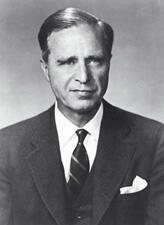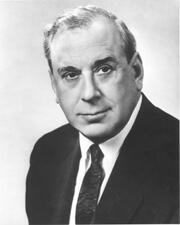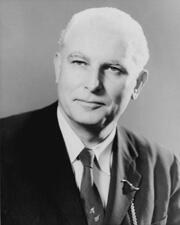
Thomas Joseph Dodd (May 15, 1907 – May 24, 1971) was an American attorney, diplomat, and Democratic politician who served as both a United States Representative and Senator from Connecticut. He came from a politically active family; his father, also named Thomas Joseph Dodd, was a delegate to the 1936 Democratic National Convention, helping to shape the younger Dodd’s early exposure to public affairs and the Democratic Party. Over the course of his career in Congress, he became a prominent, if ultimately controversial, figure in mid‑twentieth‑century American politics.
Dodd was born in Norwich, Connecticut, and was educated in the state’s public schools before pursuing higher education. He attended Providence College and later enrolled at Yale Law School, where he received his law degree. After admission to the bar, he began practicing law in Connecticut. His legal training and early practice laid the foundation for his later work in federal service and international law, particularly in the aftermath of World War II.
During World War II and its aftermath, Dodd entered federal service and gained national prominence as a prosecutor of war crimes. He worked under Supreme Court Justice Robert H. Jackson in the Nuremberg trials, serving on the staff that prosecuted Nazi war criminals following the war. In this capacity, he helped prepare and present evidence against leading figures of the Third Reich, contributing to the development of modern international criminal law and the broader Allied effort to hold Nazi leaders accountable for crimes against humanity.
Dodd’s congressional career began in the House of Representatives, where he served from January 3, 1953, to January 3, 1957, representing Connecticut as a Democrat. His tenure in the House coincided with the early Cold War period, and he participated in the legislative process during a time of growing concern over communism, civil rights, and postwar economic adjustment. In 1956, while still a member of the House, he sought higher office and ran for the United States Senate, but he lost that election to the incumbent Republican Senator Prescott S. Bush.
Undeterred by this initial defeat, Dodd ran again for the Senate in 1958. That year he challenged and defeated Connecticut’s other incumbent Republican Senator, William Purtell, winning a full six‑year term. He took office in the Senate on January 3, 1959. Dodd was re‑elected in 1964, thus serving in the Senate through a period marked by the Kennedy and Johnson administrations, the height of the civil rights movement, and the escalation of the Vietnam War. As a Senator from Connecticut, he participated in the democratic process and represented the interests of his constituents during a significant era in American history, contributing to debates on national security, law enforcement, and foreign policy. Across his House and Senate service, he held federal office from 1953 until 1971, encompassing what are often described as four consecutive terms in Congress.
Dodd’s Senate career was overshadowed in its later years by an ethics scandal that made him a central figure in one of the first major modern congressional ethics cases. In 1967, he was formally censured by the United States Senate, the first such censure since the case of Senator Joseph McCarthy in the 1950s. The censure arose from allegations that he had misused campaign funds and engaged in conduct deemed inappropriate for a Senator. This action placed him on the list of United States senators who have been censured and became a notable episode in the broader history of federal political scandals in the United States. The controversy weakened his political standing and contributed to his loss of support among Connecticut voters.
In 1970, Dodd sought another term in the Senate but was defeated by Republican Lowell Weicker, bringing his congressional career to a close when his term ended on January 3, 1971. After leaving office, his health declined, and he did not return to public office. Dodd died shortly thereafter, on May 24, 1971, in Old Lyme, Connecticut. His family remained prominent in American public life: his son Christopher Dodd served as a United States Senator from Connecticut from 1981 to 2011, and another son, Thomas J. Dodd Jr., served as a United States Ambassador from 1993 to 2001, extending the Dodd family’s influence in both legislative and diplomatic arenas.
Congressional Record