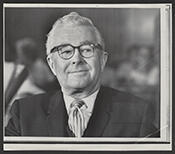
William Homer Thornberry (January 9, 1909 – December 12, 1995) was an American politician and federal judge who served as a Democratic Representative from Texas and later as a judge on both the United States District Court for the Western District of Texas and the United States Court of Appeals for the Fifth Circuit. He represented Texas’s 10th congressional district in the United States House of Representatives from 1949 to 1963, serving eight terms in Congress, and subsequently held federal judicial office from 1963 until his death in 1995.
Thornberry was born in Austin, Texas, to parents who were both deaf and taught at the Texas School for the Deaf. He attended public schools in Austin and graduated from Austin High School in 1927. He went on to the University of Texas at Austin, where he received a Bachelor of Business Administration degree in 1932. He then enrolled in the University of Texas School of Law, earning a Bachelor of Laws degree in 1936. While in law school he was a member of the Acacia fraternity. After admission to the bar, he entered the private practice of law in Austin in 1936.
Thornberry’s public career began at the state and local levels. He served as a member of the Texas House of Representatives from 1937 to 1941, representing his home area in the state legislature. In 1941 he became district attorney of Travis County, Texas, a post he held until 1942. During World War II he served in the United States Navy from 1942 to 1946, attaining the rank of lieutenant commander. After his military service, he returned to Austin and resumed private law practice from 1946 to 1948. At the same time, he entered municipal politics as a member of the Austin City Council, serving on the council from 1946 to 1948.
In 1948 Thornberry was elected as a Democrat to the 81st Congress from Texas’s 10th congressional district, succeeding Lyndon B. Johnson, who had been elected that year to the United States Senate. He took office on January 3, 1949, and served continuously in the House of Representatives until his resignation in 1963, completing eight terms. His congressional tenure coincided with a significant period in American history marked by the early Cold War, the beginnings of the civil rights movement, and major domestic policy debates. Thornberry was appointed to the influential House Committee on Rules in January 1955 and remained on that committee until he left Congress in 1963. In civil rights matters, he was among the majority of the Texas delegation who declined to sign the 1956 Southern Manifesto opposing the Supreme Court’s decision in Brown v. Board of Education. He voted against the Civil Rights Act of 1957 but supported the Civil Rights Act of 1960 and voted in favor of the 24th Amendment to the United States Constitution, which prohibited the poll tax in federal elections. On November 22, 1963, he was present aboard Air Force One and witnessed Lyndon B. Johnson take the presidential oath of office following the assassination of President John F. Kennedy; during the difficult transition, Thornberry moved into the Johnsons’ Washington residence, the Elms, to assist the new president.
Thornberry’s congressional service overlapped with his elevation to the federal bench. On July 9, 1963, President John F. Kennedy nominated him to a seat on the United States District Court for the Western District of Texas, vacated by Judge R. Ewing Thomason. The United States Senate confirmed the nomination on July 15, 1963, and he received his commission on December 17, 1963, from President Lyndon B. Johnson. He resigned from the House to assume his judicial duties, serving as a district judge from 1963 to 1965. His service on the district court ended on July 2, 1965, when he was elevated to the appellate bench. On June 22, 1965, President Johnson nominated Thornberry to the United States Court of Appeals for the Fifth Circuit to fill the vacancy created by the retirement of Judge Joseph Chappell Hutcheson Jr. He was confirmed by the Senate on July 1, 1965, received his commission the same day, and served as a circuit judge until assuming senior status on December 21, 1978. He continued to hear cases in senior status until his death on December 12, 1995, thus serving on the federal judiciary for more than three decades.
Thornberry’s judicial career nearly culminated in service on the United States Supreme Court. On June 26, 1968, President Johnson nominated him to be an associate justice of the Supreme Court, to fill the anticipated vacancy that would have been created by the elevation of Associate Justice Abe Fortas to Chief Justice upon the retirement of Chief Justice Earl Warren. The Senate Judiciary Committee held hearings on Thornberry’s nomination concurrently with those on Fortas’s nomination. After several days of contentious debate in the Senate over Fortas, Johnson withdrew the Fortas nomination on October 4, 1968. Because Fortas remained on the Court as an associate justice, Thornberry’s nomination became moot, and no further action was taken; the nomination was formally withdrawn, and he continued his service on the Fifth Circuit.
In his personal life, Thornberry married Eloise Engle (1919–1989), with whom he had three children: Molly, David, and Kate. Following Eloise’s death, he married Marian Davis. Reflecting his lifelong connection to the deaf community through his parents, he received an honorary doctorate from Gallaudet University in 1954. William Homer Thornberry died at his home in Austin, Texas, on December 12, 1995, at the age of eighty-six. He was interred at the Texas State Cemetery in Austin, closing a long career in public service that spanned state government, municipal office, the United States Congress, and the federal judiciary.
Congressional Record