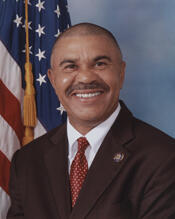
William Lacy Clay Jr. (born July 27, 1956) is an American politician who served as the U.S. representative from Missouri’s 1st congressional district from January 3, 2001, to January 3, 2021. A member of the Democratic Party, he represented a district based in the city of St. Louis that includes most of northern St. Louis County, including the cities of Maryland Heights, University City, Ferguson, and Florissant. Over 10 consecutive terms in the House of Representatives, Wm. Lacy Clay participated actively in the legislative process, represented the interests of his constituents during a significant period in American history, and became a prominent member of several key caucuses and committees.
Clay was born in St. Louis, Missouri, to William L. “Bill” Clay Sr., who would become a long‑serving member of Congress, and Carol Ann (née Johnson). When his father was elected to the U.S. House of Representatives, the family moved to the Washington, D.C., area, where Clay spent much of his youth. He attended public schools in Silver Spring, Maryland, and graduated from Springbrook High School in 1974. Growing up in a politically engaged household, he was exposed early to national politics and the workings of Congress, experiences that helped shape his own interest in public service.
After high school, Clay attended the University of Maryland, College Park, where he earned a degree in political science and obtained a paralegal certificate. During his college years he became a member of Kappa Alpha Psi fraternity, further expanding his network in African American civic and professional circles. He later attended Howard University School of Law. While pursuing his education, Clay worked as an Assistant Doorkeeper of the United States House of Representatives and participated in his father’s congressional campaigns, gaining practical experience in both the legislative process and electoral politics that would inform his subsequent career.
Clay entered elective office in Missouri in 1983, when he won a special election to the Missouri House of Representatives to complete the term of Nathaniel J. “Nat” Rivers. He served in the Missouri General Assembly for 17 years, moving to the Missouri Senate in 1991. During his tenure in the state legislature, he authored Missouri’s Hate Crimes Law, which notably included gender, sexual orientation, and sexual identity in the criteria for what constitutes a hate crime, placing Missouri among the states with more expansive protections at the time. His long service in Jefferson City established him as a leading Democratic voice on civil rights, criminal justice, and social policy within the state.
In 2000, after Bill Clay Sr. announced his retirement from Congress following 32 years of service, Lacy Clay ran to succeed his father in Missouri’s 1st congressional district. He faced a three‑way Democratic primary and prevailed with 62 percent of the vote, then won the general election by a wide margin. Clay took office on January 3, 2001, and was subsequently reelected nine times, winning Democratic primaries by an average margin of 30 points and receiving an average of 73.5 percent of the vote in his ten general election campaigns. For his first six terms, he represented the northern two‑thirds of the city of St. Louis, while the southern third lay in Missouri’s 3rd congressional district, represented by Russ Carnahan. Following the 2010 census, Missouri lost a congressional seat, and the resulting redistricting eliminated the 3rd district and expanded the 1st district to encompass all of the city of St. Louis. Then–U.S. Senator Claire McCaskill publicly criticized Clay’s role in the redistricting process, suggesting he acted out of self‑interest. In the August 7, 2012, Democratic primary, Clay defeated Carnahan, 63 percent to 34 percent, to secure the unified St. Louis–based district.
During his two decades in Congress, Clay served on the House Committee on Financial Services, where he chaired the Subcommittee on Housing, Community Development and Insurance, and on the House Committee on Oversight and Reform and the House Natural Resources Committee. He was an active member of the Congressional Black Caucus, the Congressional Progressive Caucus, the United States Congressional International Conservation Caucus, and the Congressional Arts Caucus. His voting record reflected progressive positions on civil rights, economic policy, and executive accountability. He was one of 31 representatives who voted in 2005 not to count the electoral votes from Ohio in the 2004 presidential election. He voted against the Emergency Economic Stabilization Act of 2008, expressing skepticism about the Wall Street bailout, while later supporting the Federal Reserve’s program of quantitative easing, which he argued contributed to economic recovery after the 2008 financial crisis. On December 18, 2019, he voted in favor of both articles of impeachment in the first impeachment of President Donald J. Trump.
Clay’s legislative and oversight work often focused on civil rights, environmental justice, and local autonomy. In the 116th Congress, he introduced H.R. 3435, the Local Public Health and Safety Protection Act, which sought to give local communities, for the first time at the federal level, explicit authority to enact gun‑violence prevention measures without needing approval from their state legislatures. The bill relied on the Supremacy Clause of the U.S. Constitution and tied compliance to future public safety grant funding from the Department of Justice. The proposal drew support from national gun‑control organizations, including Moms Demand Action for Gun Sense in America, Newtown Action Alliance, Giffords, Brady, and other advocates. As a member of the House Natural Resources Committee, Clay was a consistent advocate for renewable energy and action on climate change, cosponsoring the Green New Deal and supporting protections for national parks, national seashores, wildlife refuges, forests, and rivers. He was an outspoken champion of environmental justice, particularly in minority communities disproportionately affected by hazardous waste. He led efforts to secure $5 million for cleanup of the former St. Louis Army Ammunition Plant in North St. Louis, $33 million for remediation of the former Carter Carburetor plant site in North St. Louis, and $266 million for the radiologically contaminated West Lake Landfill Superfund site in northwest St. Louis County.
Clay also became a visible defender of artistic and political expression in the Capitol. In January 2017, he clashed with Republican lawmakers over a controversial painting hung in a Capitol corridor as the winning entry in a congressional art competition. The painting depicted the 2014 Ferguson unrest and strained police–community relations, including imagery of police officers as pigs. After Representative Duncan Hunter removed the painting, Clay repeatedly rehung it, as several Republicans—including Doug Lamborn, Dana Rohrabacher, and Brian Babin—continued to take it down. Clay attempted to file a theft complaint with the U.S. Capitol Police against Hunter. When the Architect of the Capitol ruled that the painting violated competition rules and ordered its permanent removal, Clay sued to overturn the decision, but a federal judge dismissed the case. Clay maintained that the dispute raised important First Amendment questions on behalf of his young constituent, asking, “How is it possible that we stand for freedom of speech and freedom of expression every place across this country, except the U.S. Capitol?”
Electorally, Clay remained dominant in his district for most of his congressional career. In the 2018 Democratic primary, he defeated Cori Bush, a candidate aligned with the Justice Democrats, and two other challengers with 56.7 percent of the vote, and went on to win the general election against Republican Robert Vroman with 80 percent of the vote. In 2020, however, amid a wave of progressive primary challenges to long‑tenured incumbents, Bush again contested the Democratic nomination and narrowly defeated Clay, winning 48 percent of the vote to his 45 percent. His loss in the August 2020 primary ended a congressional tenure that had begun with his father’s retirement and concluded after two decades of continuous service in the House.
Clay’s personal life has intersected at times with his public career. He married his first wife, Ivie, in 1992 while serving as a Missouri state senator. In 2009 he filed for divorce, a development Ivie later said she and their children first learned about through media reports and friends of their children. Through her attorney, she stated that she and the children were “devastated and embarrassed” by how they learned of the filing and that she would have preferred to prepare the children in advance. The divorce was finalized in 2011. Clay later married Patricia Beauchemin, a nonprofit executive. He is the father of two children, Carol and William Lacy Clay III. Clay and his wife reside in University City in St. Louis County, Missouri, and he is a practicing Catholic. As an African‑American member of Congress, he is included among the list of African‑American United States representatives and has been recognized for his long‑standing role in advancing civil rights, environmental justice, and progressive policy priorities at both the state and federal levels.
Congressional Record